| Username |
Post |
| ashu |
Posted
on 23-May-03 10:46 PM
Hi all,
For those of us non-theater people who are hungry for good theater productions in Kathmandu on a regular basis, here comes some relief.
The Death of a Salesman
By Arthur Mller
Enjoy,
oohi
ashu
ktm,nepal
**************************
Tribhuwan University and American Centre/ Fulbright are starting a Theatre Department at TU's English Literature Department.
The actors for this English play are lecturers and professors of TU's English Lit. Dept. The play is being directed by a Fulbright Scholar Deborah Merola, with volunteers
helping out in different areas of production.
Come one, come all.
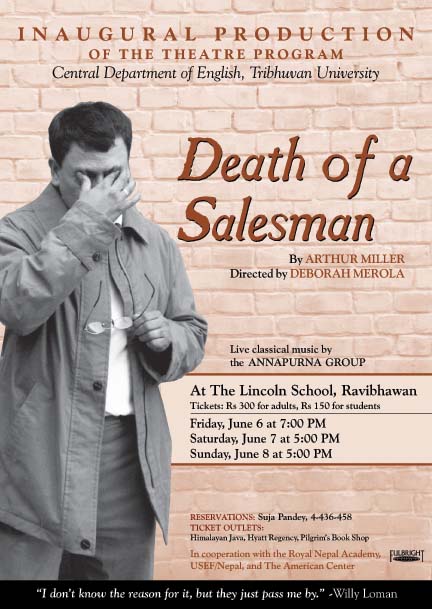
I'll try to attach the flyer.
Arthur Miller, the playright, by the way, was one of the husbands of Marilyn Monroe.
|
| ashu |
Posted
on 23-May-03 10:48 PM
Sajag Rana, an English professor who directed Great Catherine a few years ago, takes the lead role of Willy Loman. �Until now the teaching of drama at TU was so literature orientated that it was kind of incomplete,� Rana comments, �Student could not experience actual theatre production first hand--an involvement in acting, directing, dramaturgy, and design. Now it will be a holistic approach to the teaching of drama.� The creative collaboration also includes the Royal Nepal Academy, which is offering design and technical expertise for the production, and will join some TU drama classes. Hari Bahadur Thapa, Joint Director of the Drama Section, and Professors Streedhar Lohani and Padma P. Devkota hope that an ongoing partnership will develop from the project expressing the educational goals of both the non-profit Academy and the University. Streedhar Lohani explained it to the curious teachers/students on that first day, �We will be learning about theatre by doing theatre.�
The performance of Death of a Salesman in Kathmandu is turning into quite an occasion. Students from the Lincoln School where the play is performing are invited into the final dress rehearsal, with a chance for talk back with the cast. And the U.S. Embassy is offering crucial support. Deborah was so thrilled with the note from Constance Colding Jones, Director of the American Center, that she read her words out loud to me: �We'd be delighted to sponsor such a visible local event featuring American culture.� Three young American graduates of the BA Theatre Program at Hartwick College will volunteer their time helping their Nepali peers make theatre. Tim Browne and Sharad Thakur are working as dramaturges for the lobby display and program. Tim notes, �We want to present a brief performance history of this famous American play, but also discuss the choice to use an overlay of Nepali culture in the setting, costumes, and even short sections in the Nepali language when the characters are being particularly familiar or tender. And we want to interview the Nepali actors on their experience of this new dramatic process.�
Now headed into our fifth month here, I am astounded by the work that Deb has taken on. Besides presenting a play developed in experimental workshop setting, she is also teaching an Introductory Acting course, lecturing on American drama at TU�s Kirtipur campus, and leading a seminar on Contemporary American Drama and Theatre. The seminar members are currently discussing David Mamet�s controversial play, Oleanna, following an animated discussion of Tony Kushner�s Pulitzer Prize winning play Angels in America. Dr. Michael Hahn, the Country Programme Adviser of UNAIDS, and a representative of the Blue Diamond group were seminar guests and brought the social issues home to Nepal. I was present in class that day, and while the subject matter of these ultra modern American plays is often a pretty disturbing reflection of our society, their power was also clear. I guess I was expecting the seminar to be overly �academic�, but instead found the discussion unusually �alive�--people really discovering facts and feelings about their own and each other�s culture.
�The Fulbright is a positive pleasure and a great cross-cultural learning experience,� Deborah summed up. �In rehearsals, we keep talking about �the American Dream� and what that might mean more than fifty years later and how that dream might translate to present day Nepal.� And while there are no traveling salesman per se in Nepal, and a old refrigerator can signify relative wealth rather than money worries (as is does in the Loman family), and we had to find a substitute for Willy and The Woman kissing on stage (a shared glass of whiskey), still this beautiful play is very sturdy in translation. Deborah went on to consider, �There are tensions between husbands and wives, fathers and sons in every culture, even a culture very respectful to the father as head of the household. And more and more, I think, young Nepalese men and women confronted with the traditional expectations of their culture and modern enticements, might find themselves asking, �Whose dream is this anyway: My mother�s and father�s? An imported American dream? Or my own?� They may end up in a quandary like Biff, who says to his brother, �I tell ya, Hap, I don�t know what the future is. I don�t know---what I�m supposed to want.��
There are also plans in the works for a drama workshop for expatriates living in Nepal-- maybe to start things off a staged reading of Thornton Wilder�s parable for our times The Skin of Our Teeth, as well as an evening of student-directed one-act plays, and an playwriting group, maybe focused on theatrical adaptations of contemporary Nepali short stories and poetry. And while her grant ends at the end of July, Merola plans on returning in September for a three-month extension offered by the Fulbright Commission. �I want to do more advanced actor/director training and supervise some senior directors in productions of Nepali/American plays. I also hope to stage an inaugural production on the stage of the Royal Nepal Academy, perhaps a bilingual adaptation of Broughton Colburn�s well-known book about a Gurung hill woman, Nepali Aama. There is also the exciting possibility of a collaboration with Jirka Kratochvilj, a colleague of mine, who is coming to Kathmandu on an academic sabbatical.� Dr. Kratochvilj is a highly respected choral director, who for several years conducted the World Vision Youth Ambassador Chorus, which brought together 50 students from 50 different nations for international tours.
While I personally long to go trekking in the mountains and leave the noise and pollution of the Valley, I�ll have to wait until Salesman hits the stage. Performances are on Friday, June 6, Saturday June 7, and Sunday June 8 at 5:30 PM at Lincoln School. Ticket prices are 300 rupees for adults, 150 rupees for students. I�ve been drafted to help with publicity, so for more information contact Bev Hoffman at 5527694. See you at the show! �The Under Assistant West Coast Promotion Man� (title thanks to Mick and Keith of The Rolling Stones) and faithful shrimaan of Director Deborah Merola.
Merola is an Associate Professor of Theatre at Hartwick College in upstate New York, and has a residence in Berkeley, California, where she earned her Ph.D. at the University of California. An Eugene O�Neill scholar, she is also an intercultural playwright and theatre director with many years of experience. Her original productions include Children of the Sea, from Edwidge Danticat�s compelling short story about the boat people of Haiti, a whimsical Spanish/English bilingual production of Pablo Neruda�s Bestiary/Bestiario, and this last fall, Grass Songs, from Ann Turner�s book of poetry, based on the journals of American pioneer women traveling West.
|
| ashu |
Posted
on 23-May-03 10:48 PM
WILLY LOMAN IN KATHMANDU
New Theatre Program at Tribuvan University
You never know what to expect when you are married to a theatre director! A year ago I would have never imagined that I would be living in Nepal or observing an all-Nepalese rehearsal for Death of A Salesman, Arthur Miller�s quintessential American play. This January my wife, Deborah Merola, and I escaped a brutal Upstate New York winter�it was still snowing in April--to come to live in sunny Patan where two amorous monkeys recently ran past our window ledge as I worked at the computer desk.
Deborah is a Senior Fulbright Lecturer/Researcher helping start a brand new Theatre Program at Tribuvan University. Working primarily with faculty from the Central Department of English, she and a creative team have already produced an experimental version of Cuban-American playwright Maria Fórnes�s Conduct of Life, originally set in Central America but relocated to Nepal.
An adapted version of the play, which deals with issues of torture and sexual abuse, was first performed at the annual meeting of the Literary Association of Nepal (LAN). The play was then presented to students of Padma Kanya campus on International Women�s Day in an event sponsored by Amnesty International-Nepal.
The Padma Kanya campus has been the meeting place for the new theatre initative at Tribuvan University with on-going classes and daily rehearsals for Death of a Salesman. Heavy classroom chairs get pushed back in a great brouhaha of noise and dust. In the midst of one intense scene, the canteen boy served chiyaa to the loud, gesticulating actors, who tried to continue with their lines while simultaneously selecting tea with or without sugar.
A recent acting class, however, faced a different kind of improvisation. I had arrived to pick up Deborah when suddenly bricks and rocks started flying over the gated front entrance to the campus. After nearly getting hit by a rock thrown by someone who could play centerfield for the Yankees, I decided to look for another exit strategy. We retreated to the back of the campus and found a place to call out to the guards at U.S. Ambassador�s house, who kindly provided us with a ladder for a dramatic (or farcical) exit over the wall.
Improvisation seems to be a way of life here in Kathmandu, and now, due to the continuing student unrest, I am used to unexpected rehearsals taking over our living and dining rooms, and running late into the evening. I wonder what our already curious neighbors think when they hear Willy bellowing into the night, �What a simonizing job!� or �Touchdown! Touchdown!� Hari Adhikari, who plays the faded high school football hero Biff, was originally bouncing an imaginary �football� in rehearsals�he was naturally thinking of a soccer ball! So we �brought in the Marines,� recruiting two nice, young BIG American men (one actually a Marine) to demonstrate to the Nepali actors how to throw an American football and throw a punch, skills happily not needed so far in their careers as university English teachers.
Death of A Salesman continues to attract famous actors. One of my favorites, Dustin Hoffman, recently starred in a riveting film version. It was even performed in China, with Arthur Miller observing and writing about the production.
Here in Kathmandu, working with experienced English literature teachers but mostly novice theatre practitioners, Deborah comes home tired, but genuinely happy. The other night she was telling me about what had happened in rehearsal when they began exploring Requiem, the ending scene of Death of a Salesman. �I began asking the cast questions about a Nepali funeral.
Soon we had cleared the stage of furniture and begun an improvisation based on what they told me: the widow waited in her home alone, and the sons walked around an imaginary funeral pyre, good things were said about the deceased, and suddenly the famous lines that begin, �Nobody dast blame this man.� took on a whole new cultural context and power.�
|
| Biswo |
Posted
on 24-May-03 12:12 AM
Looks like a nice culturally-eventful summer is awaiting Kathmandu.
I am sure folks out there are not happy with the downward movement of Nepal's theater production. Used to be time when they used to play Munamadan, Malati Mangale etc, not only in KTM but also in cities outside. People used to flock to the local cultural centers to watch those plays. Until 2045, groups like Sarbanaam, Aarohan used to be really big thing, and Saroj Khanal, Harihar Sharma were stars of the theater.
May be because I am no more in KTM, or may be they don't exist anymore, I don't hear about any new groups, any new stars of theater, and I assume that the theaters are now not in a great shape. May be fewer people are ready to patronize them now,but we certainly miss them, don't we?
|
| ashu |
Posted
on 24-May-03 05:42 PM
Thanks San for adding this new feature.
Below is the poster for the naatak.
Biswo, theater activities in Nepal are actually getting livelier and more fun. But they still remain on the fringe of the art world here.
oohi
ashu
ktm,nepal
|
| ashu |
Posted
on 24-May-03 05:45 PM
To all the Sajha-folks in Kathmandu,
Let's go see this play on Saturday, June 7.
Isolated Freak, Arnico, Kancho and others -- what do you say?
Let's plan ahead.
BTW, Isolated Freak -- hope you get well soon.
oohi
ashu
ktm,nepal
|
| isolated freak |
Posted
on 24-May-03 08:55 PM
Thanks dai,
I am up for it. Haven't seen any play in Nepal for quite a while now, so it will be a nice experience indeed. Seems like Avi sir's personal interest on theatre has to do something with the staging of this play.
Also a short note on Kathmandu's entertainmnet scene:
Kathmandu is slowly evolving into a liberal arts college, with this happening here, that happening there in both small and large scales. In the last 30 days, the Dasrath Stadium was packed with people to see their fav. artists perform live.
Also in the movie scene, The Kathmandu Film Archive has teamed up with the French Embassy, Alliance Francaise and the French Ministry of Foreign Affairs to bring the French and Nepali animation films to the audience of Kathmandu. I could not make it to the second day (yesterday) but heard the turnout was really good. Also the KFA is planning on a Japanese Film festival of Kurasawa movies and hopefully, it will be able to make it happen within a month or two and given the enthusiasm and dedication of the KFA members.
In the musci scene, the Valley is getting rocked by various rock groups. From the Shikhar Music Beat concert to the Deepak Bajrachrya live, the Stadium gets jam-packed with the Audience. The restaurants in Thamel area usually have a live band play on Fridays. Check out these restaurants: Les Yeux, Jatra and the Bamboo Club.
And there are so many festivals, exhibitions going on in the city. Right now, a newa mahaotsaab to celebrate the newari culture is being organized in Khula-Manch. There will be festivals, photo exhibitons and music programs all of this week and the next week to celebrate the 50th annversary of the successful ascent of Mount Everest.
So, this summer is a great time to be in Kathmandu!
The jhoorest thing is I'll be missing on some of the activities for a week, but.. if you happen to be in town, go see the French animation before heading for Newari food at Khulamanch.
namaste.
|
| isolated freak |
Posted
on 24-May-03 08:57 PM
In the last 30 days, the Dasrath Stadium was packed with people to see their fav. artists perform live.
In the last 30 days, the Dasrath Stadium was packed thrice with people who didn't wnat to see their fav. artsists perform live.
|
| Nepe |
Posted
on 25-May-03 04:20 PM
Having had a brief experience of working with a theater group in Nepal and a chance of working in two relatively successful plays in not so easy time several years ago, I find a great pleasure in learning news about theatrical works in Kathmandu.
Kathmandu is said to have seen a golden era of theater sometime in 80's, when some independent group and people appeared and produced some of the finest and popular plays, a proportion of which was experimental and foreign plays. I have heard they used to have loyal and regular audience then. Shree Samuha, RangaKarmi Jamat, Arohan, Maha and other independent people were among those contributed to bring that era. Rastriya Nach Ghar and Royal Academy also produced some popular plays and operas. However, they mainly served as a cultural army of the monarchy and Panchayati Byabastha.
Then came a flood of cheap plays made by untalented people and groups which essentially destroyed the theater audience. Introduction of TV also contributed in that job. Even then, occasionally, a few plays made their way to popularity.
Ani Deurali Runchha, Muna Madan, YaMaa, Chature Ko DauPech, Edipeus Rex, Ke sakkali Ke Nakkali, Malati Mangale, Simma, Bigyapan etc are popular plays and opera from various time. Two plays that I acted in were 'Usko Kabita ma Aba Ko Rundaina' (Writer: Prakash Sayami, Director: Ramesh Budhathoki) and 'Romeo and Juliet' (Translator: Abinash Shrestha, Director: Ramesh Budhathoki ).
In my homage to late Captain Bijay Giri in a thread of Kurakani, I have talked about 'Romeo and Juliet'.
http://sajha.summitusa.com/openthread.cfm?threadid=5766
'Usko Kabita ma Aba Ko Rundaina' has been my most favorite play of all. I was told Prakash Sayami adapted it from a famous Indian novel about a Naxalite in prison (titled 'Thank You Mr. Glad'). It was a daring play to show in Nepal in Panchayat Kaal. But we succeeded to deceive the regime by making it a story of Rana Shasan. We showed it in Kathmandu for two weeks, then one to three shows in Biratnagar, Jhapa and in Funsoling (Bhutan).
I haven't kept the situation of theater in Kathmandu abreast since 90'. All I hear is how likes of Sunil Pokharel are struggling to keep Nepali theater alive.
I appreciate Ashu and Isolated Freak for being Sajha's cultural correspondence in Kathmandu. It is encouraging to see Kathmaduite's growing taste in a variety of performance art.
|
| isolated freak |
Posted
on 25-May-03 05:30 PM
I think Arohan and Sarbanaam are still staging plays, sometiems at the RNA Hall and sometiems at the Nachghar and sometimes on the streets! (sadak natak). Sadak nataks seem to be the new trend in town. I think it was last year when the Sarvanam group staged sadak natak mahotasab in KTM.
Seems like the Americans have started to fund and help the theatrical work in the valley. Before it was the FRench who did that by tranlsating and staging the works of famous french writers. And the best thing about the French was, they would also make TV serials of those plays, mainly featuring the theatre artists. I remember watching chaturey-ko-daupech and the one that started with yuddha prasad mishra's "rakta kranti ko jwala mukhi ma" .. I forgot the name of the serial though, but it was quite interesting, with three-four people locked up in a prision somewhere in France and quite heavy politcial stuff which was hard fora 7 grader then to grasp. Sunil Pokhrel, Nisha Sharma and others were the prisoners.. any idea?
anyway, la ta Nepe, jhagada aside and behind, thanks for your quite an informative message on Nepal's theatre .
|
| ashu |
Posted
on 25-May-03 06:35 PM
Nepe wrote:
>>>I appreciate Ashu and Isolated Freak for being Sajha's cultural correspondence in Kathmandu <<<
Thanks Nepe. The pleasure is all mine. After a hard week's work at the office and so on, it's always fun to relax -- watching a movie, or a naatak or enjoying music or doing other assorted cultural/artistic stuff, as a member of the audience.
Hey, you seem to have led quite a colorful life.
Enjoyed your take on the Nepali naatak scene.
oohi
ashu
ktm,nepal
|
| Biswo |
Posted
on 25-May-03 10:06 PM
Hi Nepe,
You transported me right to the past, when theater used to be big news. I am trying to remember a play by Mofasa(?) that starred ,among others, Saroj Khanal and was a hit around 2044.
Well, as far as I know, even Broadways in NY are also losing money these days, except ,of course, The Producers. So, no doubt it is tough time for theater people.
Glad to know your background. Well, I never had any doubt that you passed through a brilliant sequences of events to have acquired the clarity of thoughts that you now have.
|
| NK |
Posted
on 26-May-03 08:44 AM
Death of A Salesman by Arthur Miller is considered one of the greatest plays in American literature - "The First Great American Tragedy." It is nice that Kathmandu audience is going to experince this. But I am wondering how would the Nepali audience take this play, a quintessential American drama? This play is about (or shall I say myth?) American Dream. It talks about the West, the incessant hunger for riches, the sucess, the beauty and so on... There is a telling example, however small, in the little essay you posted how an actor immediately thought of Football (soccer) instead of the American football.
Sometimes I wonder does a play exist in a vacuum and good acting and good script are all it takes to be a successful? Do the audience need to identify with the story, with the characters to "understand" and to like it? It would be interesting and helpful if you would post something after the play is played. Or even before.
|
| ashu |
Posted
on 26-May-03 07:20 PM
NK,
I am sure as a poet you know that the beauty of great works of literature, or art or music, is that they evoke universallly valid themes. Ditto, I say, for Death of a Salesman in Kathmandu.
Though I understand your point,I really wouldn't worry much about how the Kathmandu audience would warm up to DOAS. They will.
oohi
ashu
ktm,nepal
|
| Nepe |
Posted
on 26-May-03 10:50 PM
IF wrote:
>anyway, la ta Nepe, jhagada aside and behind,
>thanks for your quite an informative message on
>Nepal's theatre .
Thank you, IF. I do not know if you would believe me, but I am always careful not to mix up political discussion with other things including my emotion and personal relationships. In discussion, I like to be brutally frank. But in relationship, I am very liberal and welcoming. I may surprise you if you ever met me.
And I also want you to know that I appreciate your postings in Sajha- those about restaurants, movies, art activities and, when they are informative and objective, about history and current issues too. Even when they are subjective and, in my assessment, biased, I still respect them as parts of our diverse world. I believe in diversity. I believe diversity is what makes our world a world. Without it, we won't be us, we won't be in motion, we won't do any progress. I believe in celebrating diversity. And I take being brutally frank about my own thoughts as a true celebration of diversity. It's not a jhagada to me. Otherwise I wouldn't say I give due respect your views.
Ashu wrote:
>Hey, you seem to have led quite a colorful life.
>Enjoyed your take on the Nepali naatak scene.
Biswo wrote:
>Glad to know your background. Well, I never had
>any doubt that you passed through a brilliant sequences
>of events to have acquired the clarity of thoughts
>that you now have.
Thank you for your kind words, friends. I certainly do not qualify for Biswoji's kind allegation, for I do have my confusion, uncertainty and doubts in thousands of things, which I somehow manage to keep from friends. However, looking back to the past from somewhat this dull present, I do find some of the things I did then colorful and educational. Although it was a 'choro baraliyeko' in my father's eyes, I enjoyed and learned a lot from my amateur association with theater and occasionally small screen too.
I do not know how many Sajhaites are old enough to have seen/experienced what it took art to survive in Panchayati regime, but I will never take the freedom and dignity we have today despite the chaotic situation as granted.
Let me share a small story. It was early days of Nepal TV, I had a chance to visit there. I respect Nir Shah as one of the gifted actors in Nepal. But what I saw inside the top floor of Singh Durbar then makes me sick even today. Nir Shah was literally the raja of that little kingdom called NTV. Everybody called him Nir Raja. Whenever he entered in any room, a wave of silent fear, awe and submission spread in the room. Everybody used to stop doing what they were doing, stand up, remain silent and wait until he finished his job and exit the room. My friends working there used to tell me that Nir Shah had told everybody that only those who support the 'byabstha' are welcome there.
Some people say it was the unlimited and unchallenged power of Nir Shah, that developed NTV. Well, may be he succeeded to get larger slice of budget and resources from the state, especially when compared to those sansthans not headed by any raja, for example, sanskritik sansthan (Rastriya Nach Ghar), but there wasn't meritocracy in NTV. There were fear, submission and disgusting chakadi-chaplusi. Creativity was secondary. Thinking was controlled. And Nir Shah openly enjoyed exhibiting his royal Shan. It was quite interesting to see Nir Shah changed overnight in his attitude and behavior the day Panchayat was gone.
NTV still seems to be sick with the illness called political interference. However, it's nothing compared to a complete dictatorship in those days.
I think IF and Biswo are talking about the same TV serial made by Saroj Khanal's troupe (Arohan). It's name escapes me. But yes, it was based on some French writer's work on French revolution. Arohan had a close association with French Cultural Center. They did a lot of French plays. They once had a regular weekend theater for a small audience in French Cultural Center in Bagbazar. It did not go very well though.
On related note, I think NK has raised some important question regarding compatibility of foreign stories to the local audience. My own experience with Romeo Juliet' and 'Oedipus Rex' (spelling ?) is that local audience in general won't identify with them, not because of the story but because of the way of presentation or the language (mechanical translation). TDOS probably won't have that problem because it is being done in the original language. Putting in some local flavor also helps. Chature Ko Daupech (stage drama and later TV serial) was liked by non-intellectual type of people too. The reason I think was it's modification to give a local form. People could easily identify with what Khem Sharma was speaking and doing.
I remember one hilarious incident (when I was watching this play in Rastriya Nach Ghar). Khem Sharma said some funny dialog in one scene with Rabi Shah. That made Rabi Shah laugh in wrong place. He could not do it without hiding his face by turning to 'Parda' for several seconds. Compare that with 'Romeo Juliet' and 'Oedipus Rex', artists hardly followed what they were speaking. Forget about the audience. Audience were there mostly out of curiosity. TDOS will have both curious as well as discerning audience. Let�s see.
|
| isolated freak |
Posted
on 27-May-03 07:32 AM
"I do not know if you would believe me, but I am always careful not to mix up political discussion with other things including my emotion and personal relationships. In discussion, I like to be brutally frank. But in relationship, I am very liberal and welcoming. I may surprise you if you ever met me. "
I am sure you are, nepe. No questions regarding that. I udnerstand that political discussions sometimes get quite heated because we all have our own strong beliefs/views based on historical, cultural and ideological premises. Therefore, at times it gets quite impossible to have an unheated political discussion, and I guess that's what happened between us.
Also, at times, we go through a wrong-set-of-words situation. Even when we don't want to be disrepsctful and civil in all our sincerity and honesty, the words we type give the somewhat different impression to the people or the set of people to whom the message is for.
So, I wouldn't judge you based on your postings.
Disagreements spice up our life. It cahllenges us to think and disagreements shouldn't lead to personal hatred . You can be friends and and enjoy beer and coffee together despite many MANY disagreements.
So, here's my concluding remark (which some of you might see as a step towards breaking the ice or a move towards reconciliation or just breaking the deadlock or ending the cold war):
"Its not our differences that divide us. Its our inability to accept, recognize and celebrate those differences."
namaste.
|
| isolated freak |
Posted
on 27-May-03 07:35 AM
want to be disrepsctful and civil in all our sincerity and honesty
disrepctful and uncivil in our communications with others, in all our honesty and sincerity....
|
| NK |
Posted
on 27-May-03 10:48 AM
Oh god If! Just stop yapping!
:))
|
| isolated freak |
Posted
on 27-May-03 10:52 AM
jasto hajurko agya, nk
|
| NK |
Posted
on 27-May-03 10:55 AM
I knew you are a good sport. Thank you. Let us (me) know how you found the play , ok?
|
| isolated freak |
Posted
on 27-May-03 11:01 AM
jo agya, hajur!
|
| NK |
Posted
on 27-May-03 07:45 PM
>I remember one hilarious incident (when I was watching this play in Rastriya Nach Ghar). Khem Sharma said some funny dialog in one scene with Rabi Shah. That made Rabi Shah laugh in wrong place. He could not do it without hiding his face by turning to 'Parda' for several seconds. Compare that with 'Romeo Juliet' and 'Oedipus Rex', artists hardly followed what they were speaking. Forget about the audience. Audience were there mostly out of curiosity. TDOS will have both curious as well as discerning audience. Let�s see.<
Most interesting Nepe. That would be a great injustice to a play if the artists are only mouthing without understanding what they are saying. Perhaps this won't be the case with this particular play (DOAS) - let's hope so - with a seasoned director and seemingly veteran literature gurus of TUs. I might be unnecessarily concerned. However, like Nepe pointed out, I think there is nothing wrong with a bit of modificatoin/improvisation. The soccer ball would have been a good example of that. The contextualization I guess.
I remember watching Euripedes's Medea in New York recently. I find this one of the most heart wrenching of all Greek tragedies. One of the most interesting thing I found about this production was how the director had added a modern swimming pool, glass sliding doors, and some contemporary children's toys without ruining the play. Mind you, this play was set in some 400 (?) BC. On the contrary, this change made the play even more real. Something we as an audience could feel and smell...
|
| ashu |
Posted
on 27-May-03 08:33 PM
>>>>>Compare that with 'Romeo Juliet' and 'Oedipus Rex', artists hardly followed what they were speaking. Forget about the audience. Audience were there mostly out of curiosity<<<<<
Nepe,
When was the last time you were in Nepal for at least two months or so?
FYI, things have changed in the cultural scene, and mostly for the better.
To its credit, the Kathmandu theater audience --composed of Nepalis and expats -- are much more sophisticated these days than it was in the early '90s. The very fact that TU is now starting a theater department with assistance from visiting American professors bodes well. [This year -- in 2003 alone -- I have had the privilege to watch four very well-produced English and Nepali plays in Kathmandu.]
Also, the arrival of new talents such as Salil Subedi (acting), Anup Baral (directing), Saroj Aryal and Sahadev Poudel (acting) and with Sunil Pokharel's opening up a theater school -- Guru Kul -- in Baneswor, things related to theater are humming.
Sure, the critical mass of theater-goers is NOT there yet to speak of a larger theater industry as such, but, as someone who has been a theater-goer in and out of Nepal for a long time, I do see lots of small yet increasingly professionally managed initiatives happening here in Kathmandu.
******************
NK wrote:
>>That would be a great injustice to a play if the artists are only mouthing without understanding what they are saying. <<<
NK,
You must think that Nepal is populated with really dumb people, with even dumber people getting into theater. I mean, come on!! :-)
Sajag Rana, playing the lead in DOAS, has been an English lecturer for years. Other actors too are either students or teachers of English. Let's trust that they will indeed do justice to the play, shall we?
Yes, TU may be a khattam place, but its graduate English department is actually very good -- attracting first-rate intellectuals from the West on a regular basis to work with the Nepali professors. For instance, last year or so, for an English Department conference in Dhulikhel, no less a person than Richard Rorty (the famous anti-Kantian/pro-pragmatism philosopher formerly at the University of Virginia) came to Kathmandu.
Nepe and NK, allow me to be your cultural guide when you are next in
Kathmandu. :-)
oohi
ashu
ktm,nepal
|
| Nepe |
Posted
on 28-May-03 09:36 AM
IF,
I wouldn't worry about the heat of debates. Also, a li'l bit of adjectives that is used to make a point but not to do plain gaali is fine for me. Alrite, let's leave it to the thread where it came from. I don't want to make NK to say 'shut up' again. (who was it who gave her upaadhi of 'kadaa maasterni didi' ?). She is right. This thread is about 'Death of a Salesman', not about 'Death of a Debate between IF & Nepe'.
*****************************
Ashu,
Although, as I confessed earlier, I do not know much about post 90's developments in the cultural scene in Nepal, I was sure things should have changed for better.
Love, heroism and art are three things that show their best in a difficult time.
I am excited to hear about new talents in town. Sunil Pokharel is the only familiar name to me. I left the country when Sunil just started his Jehad for theater in Nepal after returning from his training.
It is also exciting to hear that there are increasingly professional art events are going on. Professional management was one crucial thing missing in old times. I think this is where people like you with experties in business management and determination to make a difference can lend a helping hand to make Nepali theater a viable profession.
When I talked about translated foreign plays earlier, I did not mean artists and audience were khattam. I was blaming the poor translation for failing to produce the expected impact of great works.
I do not remember which one, but when I watched one French play in Kathmandu, I was saying to myself how could such poor dialogs be written by a famous playwright ! I thought Kader Khan writes much better dialogs than this French guy.
I think 'Romeo and Juliet' and 'Oedipus Rex' were also not translated by competent professionals. These plays sounded very odd to a Nepali ear. Not as much as that multinational Nepali film 'Haami Eka Haun', though. Anybody remembers ? Then you know what I mean.
The success of 'Chature Ko Daupech', as I claimed before, is it's Nepali flavor. Thank you NK for taking a note.
I also know one occasion when one Shakespear's Play troup (from USA ?) visited Kathmandu and showed one of Shakespear's play. My younger brother who had to study few acts of that play in his English textbook in college watched it. He was impressed by how the troupe managed to show the entire play with help of very little props, but he was not impressed by the play itself. Probably foreign accent of American artists did not go well with him.
TDOS in English with our own accent. Let's see how it goes. Waiting for Ashu's report.
|
| isolated freak |
Posted
on 28-May-03 09:43 AM
. This thread is about 'Death of a Salesman', not about 'Death of a Debate between IF & Nepe'.
hahah, well this thread has certainly amde things go in the right direction. be asured, no untimely death for our debate, even if the saleman dies. also, less use of adjectives.
will let nk and all know about the play once i see it.
namaste
|
| _BP |
Posted
on 28-May-03 09:56 AM
Personally, I am waiting for David Beeston's "Hardy Boys" to hit the scene in KTM. I hear that one was a classic.
|
| ashu |
Posted
on 28-May-03 10:12 AM
Wasserkoph,
My dear friend, you bring back wonderful, wonderful memories of some of the
happiest periods of our lives!!
Thanks a million. :-)
(What is your email?
The last one I sent you -- with a short thank-you note -- bounced back. :-(
BTW, where is Mr. Beeston these days?
In Winnipeg, Manitoba?
Looking back, it took guts for him to transform the Hardy Boys into Hardly Boys.
Finally, Wasserkoph, for how many years was the hundred-year-war fought?
Answer: for 9 miles. :)
**************
Nepe wrote:
"When I talked about translated foreign plays earlier, I did not mean artists and audience were khattam. I was blaming the poor translation for failing to produce the expected impact of great works."
Yes, this sounds more reasonable, Nepe.
oohi
ashu
ktm,nepal
|
