| Username |
Post |
| bhunte |
Posted
on 29-Jun-03 02:16 AM
Nepali Times had weekley internet poll for the last week. Here is the poll result:
<<<<< If the election were to be held next week, who would you like to see as our next prime minister to lead the country ?
Baburam Bhattarai: 34.23%
Pashupati Rana: 16.11%
Madhav Kumar Nepal: 14.66%
Girija Prasad Koirala: 8.53%
Sher Bahadur Deuba: 8.11%
Badri Mandal: 1.89%
Don't know: 16.53% >>>>>>>>
Internet users are mostly elites of Nepal. They seem to support maoist regime with a overwhelming majority. I believe the polls results on any specific issues in USA, and they often turn out to match with the actual result. On this background, do Nepali intellectuals still want hardcore communism in its soil given the day light evidence of what had happened in Cambodia and other parts of the world in the recent past? If so, it seems interesting to me to know the reason why....
|
| qallu |
Posted
on 29-Jun-03 07:56 AM
Babu Ram Bhattarai?! God help a country that chooses a murderer to lead it. But then, look at the other choices!? Not that they offer any real alternative either.
|
| (*)y(*) |
Posted
on 29-Jun-03 09:53 AM
who gives a rat's ass to that poll results??
|
| Nepe |
Posted
on 29-Jun-03 04:53 PM
Bhunte wrote:
>...do Nepali intellectuals still want hardcore communism in its soil given
>the day light evidence of what had happened in Cambodia and other parts
>of the world in the recent past? If so, it seems interesting to me to know
>the reason why....
Our own Sajha used to have poll. Many polls showed the monarch enjoyed the overwhelming support of Sajhabasi. You can always find surprising results in the Internet polls. Unless scientifically conducted, Internet polls says nothing. If anything, it says which group of people is disparate to influence the result. That's all.
Nevertheless, the growing influence of the Maoists in urban elite of Nepal is observable fact. In this context, the recent outbrust of our Ashu's resentment over it in the thread 'Kanak Mani ka bicharharu' is worth referring. I have not yet understood him fully. However, one seemingly unimportant statement by another poster Poonte ji who enjoys my respect for his moderate views suddenly made me ask if he and other politically opinionated Sajhabasis have accurate picture of evil Maoists.
I could have posted this to that thread. But the titlewise, I found this thread more appropriate to post my thoughts.
Let me start with Poonte ji's statement.
" ..I am also convinced that the level and frequency of atrocities committed by the Maoists may very well be far greater than those committed by the state forces. "
I have read similar statements by several prominent Sajha commentator. Now, do all Sajhaites or all Nepalis for that matter share this belief ? I don't think so. And I think this is what should explain the question asked by Bhunte ji above.
Let me give you some facts and figure regarding the evils of the Maoists vs the state which are in public domain thus available to all. I think these facts are going to ask Poonte ji and Ashu ji some serious questions.
--------------------------------------
Excerpts from Amnesty International Repot 2003 Nepal summary
http://web.amnesty.org/report2003/npl-summary-eng
Extrajudicial executions
The security forces continued to carry out unlawful killings. It was estimated that of the more than 4,000 "Maoists" officially declared as killed since November 2001, nearly half may have been unlawfully killed. Those unlawfully killed included civilians suspected of providing shelter, food or financial assistance to the Maoists. They also included members of the CPN (Maoist) killed in circumstances where they could have been taken into custody or where they had already been taken prisoner.
'Disappearances'
People continued to "disappear" after arrest by the security forces; more than 65 people had "disappeared" since late 2001. "Disappearances" were facilitated by the TADA, under which people were held incommunicado for prolonged periods in secret and illegal detention at army camps.
Torture and death in custody
Torture by the army, the paramilitary police force (the so-called Armed Police Force � APF) and the police was reported almost daily. The APF, which was established in 2001, was increasingly cited in allegations of torture as it became more active during the year. The army systematically held people blindfolded and handcuffed for days, weeks or even months. Torture methods included rape, electric shocks, belana (rolling a weighted stick along the prisoner's thighs causing muscle damage), beatings with iron rods covered in plastic, and mock executions.
Arbitrary arrest and detention
Thousands of people were arbitrarily arrested and detained. They included lawyers, students, journalists, teachers, farmers and other suspected members or sympathizers of the CPN (Maoist). According to official figures released in August, 9,900 "Maoists" had been arrested since the imposition of the state of emergency in November 2001, of whom 1,722 remained in custody. District Coordinating Committees decided who should be arrested, detained or released often on the basis of information provided by mainstream political parties. Chief District Officers issued blank detention orders for use by the security forces. The army denied holding detainees, but there was overwhelming evidence of people being held for long periods incommunicado in army barracks. Prisoners were usually held outside any legal framework. Those held under the TADA were rarely produced before a court.
Impunity
Victims of human rights violations failed to gain redress, and official accountability was widely lacking. The judiciary was largely bypassed or failed to assert its authority or confirm the rule of law. Habeas corpus remained an ineffective remedy in relation to "disappearances" and for those detained under the TADA. The Supreme Court persistently postponed making a decision on around 12 habeas corpus petitions put before it since late 2001. Police and the judiciary put obstacles in the way of victims trying to file cases or requesting medical examinations in order to gain redress under the Torture Compensation Act. An officer implicated in the death of Krishna Sen was awarded "policeman of the year".
Sexual abuse of refugees
Sexual abuse of women and children in Bhutanese refugee camps in Nepal was reported. An investigation by the UN High Commissioner for Refugees revealed 18 cases of sexual abuse and exploitation in the camps by aid workers; one victim was a seven-year-old girl.
Maoist abuses
The Maoists stepped up attacks on members of mainstream political parties in the run-up to the elections set for November. Members of the Nepali Congress (NC) party were most often targeted for deliberate and unlawful killings, but there were increasing attacks on members of the Communist Party of Nepal (United Marxist Leninist). The Maoists also tortured captives, took hostages and linked their release to certain demands, and recruited children into their ranks. They were also responsible for the summary execution of members of the security forces taken captive during attacks, particularly on police stations.
------------------------------
|
| Nepe |
Posted
on 29-Jun-03 04:54 PM
Human Rights Monitoring Report 2002 by the National Human Rights Commission, Harihar Bhawan, Lalitpur
http://www.nhrc-nepal.org/doclinks.asp?group=Papers
page 13:
B) Rape:
i. Rape Committed by the State Party:
The incidents of rape committed by the security forces are mostly incidents of gang rape. In several cases, it was found that the army personnel went to various houses, beat and dragged the husbands and the children out of the house and then raped the women inside their houses. Similarly, incidents of arrests followed by the killings of husbands and subsequent raping of their wives were also discovered. It was revealed to the monitoring team that an army squad took two women detained in Dailekh with them to an undisclosed location and then raped them. Their naked bodies were left at the location and the news was dispatched stating that terrorists were killed in an encounter.
ii. Rape Committed by the CPN (Maoist):
In one of the districts visited by the monitoring teams, two gunmen in masks and black dress entered into a house at one o�clock in the night. While they compelled the parents at gunpoint to sit on a cot, they brought the daughter who was sitting in a corner of the same room and made her take her clothes off. When she refused, the gunmen tore off her clothes and raped her turn by turn. The gunmen broke a box belonging to a family and took away Rs. 20,000. They did all this because of the refusal of the parents to donate one hundred thousand rupees to the Maoists. The mother of the girl suffered serious mental trauma from the incident, which consequently led her to commit suicide by hanging herself a few days later.
Irrespective of whosoever might have committed such rapes, it is a cruel and inhuman act and a grave assault against personal dignity. Such incidents are at a violation of both human rights as well the Common Article 3 of the Geneva Convention.
===================================================
.

|
| Nepe |
Posted
on 29-Jun-03 05:04 PM
Simple math from the NHRC report (also note that this is from a sarkhari institution):
Total abuse: 445
By the Maoists: 177 (40 %)
The state: 268 (60%)
|
| isolated freak |
Posted
on 29-Jun-03 08:20 PM
Add the right wingers percentage instead of focusing more on BRB. Then you'll know the answer. Data analysis in Political Science is very interesting because more attention should be paid on political ideologiy(-ies) than on a single person/party, because politics is all about forging alliance(s)/gaining support.
This poll speaks for itself. 34% of Nepal's population would like to see BRB as PM.
Now, givfen the Maoist ideology, none of the others are likely to forge an alliance with them. This means, the Maoists are confined to a mere 34%.
Now, lets add up figures of GPK-PSR-MKN-BM-SBD (because the chances of these alligning to oppose the Maoists are high): aroud 50%.
This means, 16 % more support than the Maoists.
Now, tehre's 16% undecided. So, if the leaders--MKN-GPK-PSr-BM-SD--focus on gaining public support, then, chances are that 1% (minimum) will support them, which means = 52% almost.
So, the leaders at this point need to focus on propoganda.
The poll also clearly indicates that Nepal is not ready for a maoist governmnet, if it means a total change in the present structure. 50% supporting the right wingers and 34% supporting the Maoists =?. My analysis: Nepal is not yet raedy and willing to see BRB as PM, nor wnat any change in the present political structure.
namaste
|
| yoUnGbLooDZ |
Posted
on 29-Jun-03 08:53 PM
"damn the PMs r chaning like mah cousin changes his diaper"
NONE OF THE PEOPLE FRM THE POLE>> i think can be a PM of nepal....
they should go n hunt fo PM in goreto gaun.. naya gaun.. pahadi elaka.. get sum gober ganesh (atleast they gonna be loyal to the country).. n m sure they will do better then.. these trash (those frm the poll list)
yb
|
| bhunte |
Posted
on 29-Jun-03 10:29 PM
IF jyu,
My concern is how much the popularity of big parties have fallen down. Just think of the combination of NC and UML percentages is still lower than maobadi's. NC alone used to have over 60% vote right after 1990's movement, and now in the above poll it is merely 16% combining deuba/girija force. UML used to have about one third of the population representation. If you add together the votes of all fragmented parties, indeed it is higher than maobadi's. But, their hold on one third of population (if the poll truely represents them) is not a joke. Moreover, horsetrading in Nepali politics has not been so successful to claim on the votes of non-maobadi forces.
Yes, Nepe ji is true that internet poll may not be precise in Nepali context. But my point is since when our elites (those with internet access for example) who have the responsibility to steer the country were seen to be more inclined to ultra left lean. Yeah, it is hard to tell who voted there indeed. They might be lot of unemployed youts in cyber cafe in nepal who in their desperation/frustration might have made their decision in favor of BRB.
Nepali poll testai testai ho huna lai ta, tara yeha ko President ra state Governer ko election ko dui patak herne mauka milyo. tara yeha ko poll result actual result sanga match garya thiyo. nepal ko anubhav chhaina ahile ko paristhiti ma....
|
| GP |
Posted
on 29-Jun-03 11:53 PM
Questionnaire based results are largly influenced by:
1. The target group.
2. Who conduct it.
3. who get access to those questionnaire: biased or unbiased. Truely mixture of all kind of peoples from Target group.
4. Do you use : Filter or sorting out method. In webbased poll, usually, one IP address One Voter is a most commone and cheapest method of sorting out multiple clickers. Some use cookies: does not work, when spammers know how to delete and cookie and Re-Click ............ If one IP one vote is used, hardly any real number of voters will be able to vote from Nepal, because large number of internet surfers are using public cyber cafes. Now, there is dynamic IP addressing, it also allows clever voters to vote multiple times, while Sidha-Sadha voter will never get chances.
5. I consider this NepalNews.com poll is simply a Bayes Theory based voting, I wonder whether it represents the full picture outside Bays Filter. Thus, among voted almost 1/3 preferred BRB as next PM. So, question that is never answered is Who were those voters ? Its not a polling among pre-registered voters, e.g. you keep a record of registered voters and allow vote to only among them. It is more precise, compared to what you find in Nepalnews.com. Thus, NepalNews.com does not represent real voters with wide bandwidth to make accurate guess.
6. Lets not forget the voting / polling in BBC last year. The Nepali song was ranked top 10 ? How ? There was a biased campaign. A certain group ran a campaign asking peoples to vote only the target music from Nepal. Thus, almost all Nepalis who voted they voted only to that particular music, while the campaigner did not expect other musics to be voted by Nepalis.......... They created a gap, created a sensational, created an emtional appeal ............... if we all unite, we can make a Nepali song on top of worlds best 10 songs........... while there were many best songs around the world, but, the information was never disseminated to the same rank as that Nepali song. Do we really think that Nepali song deserved to be ranked as top 10 songs? We were not (including me: I also followed the campaigner's appeal) honest in that voting.
I wonder the Maoist supporters like Maoist students who went to schools and forced student to get membership: a show biz to falsly show that 95% of Nepal's students are ANNFSU Members? Do we really accept that result? claim? Of course not? It is exactly like the 100% support on Saddam's government.
So, the Nepal news.com poll does not represent real opinion of the public. What they need is first a database of wide bandwidth of Nepalis: especially email based, and they send PIN code to email and ask to vote using PIN. .............Well, there are many
options, but, Nepalnews.com can create a email registration system, just the way NY Times does. Free registration, and carries out poll. WEll, there can be some guys with
multiple registration, but, this is cumbersome to twist the result as much as in free Nepalnews.com.
So, this result is completely a bogus, at least for me, its bogus in the same degree as in ANNFSU's claim of having 95% students being their union's member.
GP
|
| Poonte |
Posted
on 30-Jun-03 09:38 AM
Nepe-ji,
Thank you for bringing the reports of AI and NHRC to the attention of Kurakani discussions--it obviously sheds more light into the matter.
Now, about the statement that I made in another related thread. The statement in question that you have quoted:
"..I am also convinced that the level and frequency of atrocities committed by the Maoists may very well be far greater than those committed by the state forces."
Yes, I remain partially corrected on this statement. The use (or the misuse there of) of the word "convinced," I have realized, may have contributed to your miscomprehension of what I actually meant to say. My apologies for the confusion. However, if I may bring it to your attention, I have followed up on the same statement with the word "may," which supports the fact that I was not sure whether the Maoists or the state may have committed more atrocities than the other. I did not know the facts simply because I had not been following the reports of human rights violations as closely as I would have liked myself to.
Now, putting this assertion and the rest of the context of my argument in the other thread together, please be advised that my seeming accusations that the Maoists perhaps committing more atrocities than the state was merely to say to Ashu-ji that even if the Maoists may have committed more human rights violations, we still need to be open minded about negotiating peace with them because the alternative is undesirable.
Nevertheless, I would also like to point to a fundamental flaw in the AI and NHRC reports. I have tremendous respect for both of these organizations, and I think they are doing a great job of bringing to light the human rights violations committed by the warring parties. Nonetheless, however responsible and balanced those organizations maybe be, one thing that they CANNOT do is account for the psychological aspects of other "softer" kinds of human rights violations. The reports that you have posted above accounts for the direct and tangible violations such as rape, abductions, torture, damage to infrastructure, etc. There are several examples of other aspects of human rights violations that the reports omit, although I am sure not on purpose:
-- the forced closures of schools (violation of children's right to education)
-- the extortions (violation of right NOT to "donate" if they choose so)
-- the bandhs and chakka jaams (violation of right to free movement). I know that other political parties are also equally guilty of this crime.
...there could be more.
Even though it is virtually impossible to gauge the accurate effect (in numbers) of these non-tangible/"softer" violations of human rights, hence perhaps the above reports omit these aspects, I believe we all can agree on the fact that the long term psychological and emotional damages that these violations can put on the society would be tremendous.
Mind you, this is NOT to undermine the necessity, and the utility, of the kinds of reports that you have posted above.
|
| Bhunte |
Posted
on 30-Jun-03 11:30 AM
pooo lai parnu pir paryo ki ke ho.......eheheh
|
| Bright Eyes |
Posted
on 30-Jun-03 12:16 PM
Even to a beginner in the art of statistics like myself, it seems a little absurd to see the importance attached to these polls.
Nepali Times , Sajha.com or any other internet 'polls' do not reflect opinions of majority of Nepalis. They reflect the opinions of less than one percent of Nepalis, or Bipalis, who use the internet and make an effort to cast online ballots. The non-random nature of participants and the selection bias that it leads to should be very clear to everyone.
Its like asking the Sukumbasis ( who, incidentally, make up more than 1% pop), the same question and analyzing the national mood based on their responses.
I was surprised to read a piece on Nepali Times that used their online polls that tried to do exactly that. Very misleading.
|
| Bhunte |
Posted
on 30-Jun-03 01:01 PM
________Even to a beginner in the art of statistics like myself_________
now time to open bright eyes.
of course there is a selectivity bias in the internet poll which has already been admitted for by saying the opinion there represent for those who have an access to internet. but, the point is about the distribution of the poll result. The poll says there are one third of population in this sample who support ultra left ideologies. Isn't this a significant? It tends to be in contrary to the steriotypic perception that elites are in favor of democratic ideologies-- a very general null hypothesis. anyway, poll result is poll. we will see how it turns out when there is a real election in nepal if anytime soon...the result may change by any significant event, as who knows that who things turn in nepal in a matter of second....eheheh
|
| Bhunte |
Posted
on 30-Jun-03 01:12 PM
correctum:
"...who things..." = "...how things...."
|
| Bright Eyes |
Posted
on 30-Jun-03 09:37 PM
Bhunte,
We don't kknow many things about that poll:
i) the selection was non-random which means that we can not infer about the population as a whole from the results.
ii) we don't know the sample size. With small sample sizes, the standard error is usually so big that the conclusions are meaningless.
iii) we don't even know if the poll was fair. Conceivably,one single person can log in on any number of computers and skew the results as much as he/she desires. So the poll should not be used to infer anything about the sample itself.
I'm hesitant conclude that the poll is trustworthy enough to tell us anything about the sample in question itself, let alone the whole population.
|
| Bhunte |
Posted
on 30-Jun-03 10:00 PM
Bright Eyes bro,
You are true to some degree, but there are some other ways to verify the poll result. Reelection would be an excellent way to compare it but we won't have it any soon. However, you may use other proxy information such as the number of people behind current agitation, julus, dharna, etc. led by pancha parties. For example, if you have regularly visited nepalnews.com and kantipuronline.com there you would have found photos of different julus and 'dharna' led by different parties, and where you can see scanty people. I was surprised when i saw more neta's faces than people. Few people were behind them eventhough there r different stages of movement, like pahilo charan, dosro charan, tesro, chautho,...Even then there we find few people behind leaders. And parties seem to be on the verge of dissociation. Earlier in such program, many streets used to full of people, etc. So, in that way the poll is alerting and reflects something. Just a thought....
|
| allare |
Posted
on 01-Jul-03 04:57 AM
Who says that poll is sceintific one and represents the view of all nepalese? Its just simple poll where any one can vote as many time as they want with some trick. But again, how could one say those who favour other people compare to BRB has not voted twice thrice..
While reading the post here who says that Poll is biased and blah blah, have you not heard that in every election, the party/leader who lost and not in govt says that Poll was not fair. While Bavdev was DPM(or home minister.. i forgot) and conducted local election, UML got majority and did not other party including NC blamed the then govt of ManMohan for not carrying out election fairly? So,most of time, loosers will always claim that Poll was not fair. And it is truth that, Polls are never fair, but again you can not claimed that its totally false. In overall, it does represent the opinion of general mass, just percentage might be little bit plus minus.
And yeah, I also voted in that poll for BRB, but just one time.
|
| Bright Eyes |
Posted
on 01-Jul-03 08:38 AM
Allare,
What are you on about? Losers may always claim that polling was not fair.But the losers are right sometimes. In Nepal, they're probably even right most of the time.
I'm just pointing out the danger in accepting the Nepali Times/Nepalnews.com and other internet polls in general. Using your example, these internet polls are like elections with few extra characteristics. e.g. Most people don't know that a poll is going on and anyone can vote as many times as they want. They are carried out very loosely but if you want to trust them, go ahead and fool yourself that BRB is the most popular politician among the richer class in Nepal.
|
| ruck |
Posted
on 01-Jul-03 08:45 AM
Internet poll???
Does this poll represent the whole of Nepal ??? what about the ppl in the remote villages and the ones who don't have access to the net and the ones who are not computer literate??
Bhunte dai,
"Internet users are mostly elites of Nepal. They seem to support maoist regime with a overwhelming majority" --
Do you think so??
|
| Bond-007 |
Posted
on 01-Jul-03 09:23 AM
Gallu Ji,
-----------Babu Ram Bhattarai?! God help a country that chooses a murderer to lead it-----------
Who do you think is leading a country at the highest level, isn't he a killer? Even the person to succeed him is a known killer. What a combination it will be, from top to bottom, a country led by killers. Said so, if that's what the majority wants fine with me.
Let's not forget Nani Mayya Dahal, Padma Ratna Tuladhar and Jog Mehar Shrestha got the blessings of Kathmandu elites and Krishna Prashad Bhattarai and Daman Nath Dhungana etc. didn't and we all accepted the results. Any thing is possible once the matter is in public hands.
|
| Bhunte |
Posted
on 01-Jul-03 10:10 AM
ruck baini,
that was not my opinion but i was alerted by the poll outcome. i checked that again in an another poll, but the result was resilient. it reminds me winning vote of nani maiya dahal, where she got overwhelming majority from kathmandubasi. r hard to pometimeredict elites' mind....
baini, yo sajha ka garunga acchher na oochalnu hola hai...yesterday i made 'golveda ko acchar' with timoor...ahhh jibro parparaundai chaaa ratatataaaaa....timoor ko yad dilaunu bhako ma dhannebad...
|
| Bhunte |
Posted
on 01-Jul-03 10:28 AM
correctum:
...... r hard to pometimeredict elites' mind....
sometime hard to predict elites' mind ....
heavy words in sajha and eyeless fingers.....eheh
|
| Bhunte |
Posted
on 15-Jul-03 04:45 AM
Hey friends, Baburam has himself replied related to this thread as published in Nepali Times. Read as is below:
Baburam Bhattarai Replies
I was quite amused to read in your esteemed paper (Nepali Times/Nepalnews.com Poll, #91) last week that the largest number of email voters have chosen me as the prospective �prime minister� if elections were held today. While expressing gratitude to the voters for their kind affection, I would reject the offer for its misleading political connotations and consequen-ces. It is impossible for our party and me personally to think of occupying any post, howsoever high and prestigious it may be, within the prevailing state dispensation. The ongoing Peoples� War and recent peace talks are aimed at a progressive, democratic change in the state system as a whole and not any cosmetic change in the government within the old state. Let there be no doubt, at least amongst the enlightened English-speaking urbanites, on this fundamental political question. There is just no chance of our sharing the spoils of power within the present autocratic monarchical system, whether through showcase �elections� or no elections. I would once again reiterate that the bottom line for any political compromise at the moment is a roundtable conference, interim government and elections to a constituent assembly. And nothing more or nothing less. I hope I have not hurt the feelings of your enlightened email voters.
|
| Neta_ji |
Posted
on 15-Jul-03 02:21 PM
It is woefully sad and frustrating to acknowledge that the majority of the analysis carried out by different experts and so called �polls� still cannot see the picture beyond the perceived choices of the population between the right wing (so called �old establishment�) and left wing (so called �new establishment�) and the candidates from the respective establishments. After more than 7 years into the Maoist revolt, the experts and their analysis still seems to be lost somewhere trying to figure out which side of political equation might have been or will be preferred by the majority of the population.
To me, the question of whether BRB should be the next PM or whether the Maoist should head the government is not even the central sticking point for the clash between the different corners of the Nepali politics and the political affiliation they represent. I don�t feel even if the Maoists head the government under the existing tattered regime or completely replace it with the communist regime, the Maoist too will face similar collapse if they too disregard the core problem of the Nepali society, politics and economy. The core problem of the past and the present Nepali society, politics and economy is the lack of proportional share in accordance to the (ethnic) racial make up of the population and their participation in representation and decision making in the matters of national affairs. The creation of Nepal as a state about 240 years ago had had merely been a unification of lands by incursions into the once autonomous ethnic territories, not the integration (by participation) of different ethnic societies into the mainstream. The ruling castes who controlled the state powers though out the history did not have had a vision of a new nation, they were simply expanding their real-state business.
To see the picture of the horrifying picture of the share of the different ethnic group in Nepali society, here is a recent data collected by a Canadian charity organization based in Ontario, Canada called Nepal Schools Project.
Brahmins, Chhetris and Newars make up approximately 10% of the population of Nepal. Yet, these three groups represent the following percentages in public life: 93% of key civil service posts, 94% in the judicial system, 94% in the national administration, 83% in senior professions such as doctors and engineers, 87% of all army officers, 60% of the members of the Lower House of Parliament, and 70% of the Upper House.
Changing the form of a government or the entire political system is not an end for the unrepresentative and underrepresented ethnic communities. The experts and the other concerned sides of the debate must recognize it as the fundamental source of past and the current chaos, unrest, anarchy and clash in the Nepali society, if not, all the debates arising from this fundamental problem will be nothing more than beating around the bush. Unless there is a dramatic change and call for action to address this issue, either by the remnants of the existing regime or the Maoist, whoever may take the place or head the government will not be able to solve the anarchy and clash. Ethnic revolt is a gathering storm and throughout the Nepali history the people who held the state powers had never had a time to fee far into the future.
It was strange to witness that the despite such a great injustices these ethnic communities did not stage an armed revolt. Despite a large participation of ethnic communities in the Maoist revolt, the unrepresentative and underrepresented ethnic groups are not interested in fighting for the establishment of a communist political system nor did or does unrepresentative and underrepresented ethnic communities ever ask for any specific form of political system. In the country like with over 70 different ethnic groups and 50 languages there should have been and must be a wide open debate about how such a system can be put in place that can ensure their fair share in the national politics, society and economy if not the continued disregard for their main agenda is leading to an ethnic revolt from with in the Maoist revolt which in fact will be of far greater magnitude and messier than the one we have seen in the Maoist revolt. Till this date the Maoist have gained considerable notice nationally and internationally only because they are first one to stage an armed revolt of this extent in Nepali history.
The present debate of whether BRB should be the next PM does not make difference and does not address the core issue. The present chaos, unrest, anarchy and civil war is likely to linger on for years and transform into greater war under constant diversion from the debate from the core issue.
|
| KaleKrishna |
Posted
on 15-Jul-03 06:52 PM
I am confused whether the ethnic conflict be given a priority or channelling their grieviences and sddressing them be given one.
Divide and rule should not be the political ideology into the 21st century. I guess the best way should be to encourage upliftment of backward societies regardless of ethnicity majority of the remote rural Nepalese are poor.
Equal participation comes with education and that does not necessarily comes with wealth (Laure's agony) explains clearly. I feel not relying on the illoccupied gov, the populace have to initiate the way for equal opportunity. It must be considered that reservations for any minority communities (in Nepal this term is not relevent) hardly goes to the needy and it is mostly cornered by the cream of that particular comunity (Indian experience).
So, who ever be the next or future PM, far sighted vision in formulating strategies and their adoption towards just, equal and responsible society is the only solution.
|
| Neta_ji |
Posted
on 16-Jul-03 12:18 AM
It is very much likely that the time period for channeling the grievances (and addressing their fundamental concerns) has almost exhausted . It did not happen in through out the history and it is very unlikely it will ever take place because we have neared the final phases of the end of central control by any administration of any political system. At this phase the only thing the tattered administration can do is control the extent of the damage resulting from the impact. We can look back at the provisions of the Constitution of Nepal, 1990 (as a legal tool) is a testament to the never changing attitude of the elite castes.
The political change in 1990 had provided a rare opportunity to address their core issues however the same old issue of ��lack of representation�� screwed up the things. The introduction of the new constitution in 1990 offered a chance to reconsider the state's politics of nationalism. How did the ruling elites use this opportunity? Article 2 of the constitution defines that all "Nepali people irrespective of religion, race, caste or tribe collectively constitute the nation (rastra)." This sounds positive since no section of population is excluded. But this positive aspect is revoked by article 4 (1) which, on the one hand, concedes that Nepal is a multiethnic and multilingual state but, at the same time, defines the country as a Hindu kingdom (hindu adhirajya). This definition as Hindu state is underlined by a number of symbols mentioned in the constitution like the flag and the coat of arms representing different aspects of Hindu myths and society.
Another important aspect of the constitution is the definition of Nepali as the language of the nation (rastra bhasa) (article 6). ((Additional info: The constitution of the United States does not define English as the official language of the nation despite the fact that it�s the mother tongue or the only language spoken by 82.7% of the total population of the country according to the latest census release by the US Census Bureau on January 22, 2003.))
Of course, the country is in need of a common language, and there is no other language as widespread as Nepali. But it is the mother tongue of only 53% of the population according to the census of 1991. For the rest of the population, Nepali is some kind of foreign language. Having only rudimentary knowledge of colloquial Nepali these people feel deprived of their fundamental rights guaranteed elsewhere by the constitution, especially in face of the ever growing Sanskritization of the high standard language to the detriment of indigenous terms.
Thus the ethnic elites regard the national language Nepali as another symbol of high Hindu caste group. Against the background of Nepal being a multilingual country social tensions are to be preprogrammed the faster the political and social consciousness of the ethnic groups is growing. The constitution has named the other languages as national languages (rastriya bhasa) without providing further specification. That they are not meant for official use has quite been declared by the Supreme Court, when the District Development Committees (DDC) of Kathmandu, Dhanusha and Rajbiraj were prohibited to use Newari respectively Maithili during their meetings
During the drafting phase of the constitution in 1990 the transformation of Nepal into a secular state had been demanded by ethnic and women organizations as well as by representatives of the Buddhists, Muslims, Christians and the so-called untouchable Hindu castes. But there had been a vehement opposition against this idea from Hindu traditional organizations which had strong propagators within the then interim government, the greater political parties and sections of the press.
The chairman of the Constitution Drafting Commission and later Chief Justice, Vishwanath Upadhyaya, called all demands concerning religion, language, caste and ethnicity, which comprised about 90% of the public recommendations, as being of minor importance for a democratic Nepal, comparing them to communalism:
-- ��Statements which foster communalism and sow the seeds of religious intolerance cannot be justified. Such improper tendencies, if not checked in time, will create obstacle in our efforts to establish a democratic constitutional system.��--
That only a non-Hindu alignment is regarded as communal can be seen from Article 112 (3) which denies the recognition of any political party or organization formed on the basis of religion, community, caste, tribe or region. Must not the state itself be called communal because of its Hindu affiliation? This is further verified by the fact that after 1990 regional parties were recently recognized as long as they did not oppose the Hindu state (for example Nepal Sadbhawna Party is the only regional party with almost exclusively made up of people of the Madesh region and does not oppose Hindu state). Now, this particular provision of the constitution [Article 112 (3)] has proved the most damaging (suicide article) to the system&&&& continued below
|
| KaleKrishna |
Posted
on 16-Jul-03 01:05 AM
Ethnic division and hatred is not the solution. Netaji true to the name the point you have mentioned deserves praise and deep thoughts. But, I guess you do not know the demonic face of ethnic division. I have personally experienced it and the pain and sufferings that as a kid I saw befall on fellow Nepalese is hard to explain. Then the small sub divisional of ethnicity did not matter it was communal, hence there are vultures on both side of the ethnic comunities who will not abstain from manipulating any small rift.
Hence,I pray sensitive issues like this one has to tackled with more wise and judicious approach. It is not again that it should just be brushed aside and the injustice continued.
The last effort to educate ethnic community to denote their particular religious belief and ethnicity in the last census had bore excelent result. The work done by educated members of the same comunity has to be praised. In the same vien developement works and awareness of the rights and responsibilities as that ethnic member and as Nepali in broader asspect has to be empashized.
Division on the basis of anything is easy to achieve but cohesion will take centuries and may never ever remain. One should be proud that unity among diverse ethnic community has been our identity. To feel it better pardeshi life experience will help.
|
| Arnico |
Posted
on 16-Jul-03 11:56 AM
Note BRB's reply in the latest issue of the Nepali times:
***quoted****
-------------------------------------------------------------------------------------------
Baburam Bhattarai Replies
I was quite amused to read in your esteemed paper (Nepali Times/Nepalnews.com Poll, #91) last week that the largest number of email voters have chosen me as the prospective �prime minister� if elections were held today. While expressing gratitude to the voters for their kind affection, I would reject the offer for its misleading political connotations and consequen-ces. It is impossible for our party and me personally to think of occupying any post, howsoever high and prestigious it may be, within the prevailing state dispensation. The ongoing Peoples� War and recent peace talks are aimed at a progressive, democratic change in the state system as a whole and not any cosmetic change in the government within the old state. Let there be no doubt, at least amongst the enlightened English-speaking urbanites, on this fundamental political question. There is just no chance of our sharing the spoils of power within the present autocratic monarchical system, whether through showcase �elections� or no elections. I would once again reiterate that the bottom line for any political compromise at the moment is a roundtable conference, interim government and elections to a constituent assembly. And nothing more or nothing less. I hope I have not hurt the feelings of your enlightened email voters.
And more to the point, I would like to add something else to this short letter, which may be somewhat out of context. This concerns an earlier report in Nepali Times (�Class of 1970�, #142) about my school days in Amar Jyoti High School, Luitel, Gorkha. While most of your reporting was quite objective, there were some serious, if not deliberate, omissions. While talking of people who made a great impact on my childhood and contributed to the rise of Amar Jyoti High School to national glory, one can never forget a great lady called Miss Eleanor Elkins. A devout Christian missionary from Scotland, now settled in New York, she was single-handedly instrumental for the excellent quality of education and discipline in our school for more than two decades. I can never forget her, even though your reporter conveniently omitted her while writing about Amar Jyoti. There can be no objective history of my school and my childhood days without that great soul, Miss Elkins. Let her �god� bless her forever! At least thousands of her students will cherish fond memories of her throughout their lives. You also missed the name of Verghese Thomas from Kerala, who was actually the headmaster of our school when we passed out in 1970. Maybe you got �Thomas Verghese� and �Verghese Thomas� mixed up. As far as I remember names and dates correctly, Thomas Verghese, the earlier headmaster left the school in 1968 and Verghese Thomas took the mantle successfully till the mid-eighties. Hence it would be a gross injustice to omit Verghese Thomas� name, who was a good mathematics teacher as well.
Baburam Bhattarai,
courier
|
| Neta_ji |
Posted
on 16-Jul-03 02:23 PM
Before proceeding to the question of whether it is an attempt to create animosity and rift between different groups of the society of the nation one should go back at least 240 years ago and see the status and reality of the race relations in the period before the formation of Nepali state.
Various states and kingdoms emerged and dissolved during the course of thousands of years in this Himalayan region. During the course of thousands of year right up until 240 years ago, did the caste based system ever exist in these small self-ruled states. Did any caste or group of people impose a strict social, political, economic and legal control over other groups in order to impose superior group�s religion, belief and culture as the way to maintain the superior group�s absolute supremacy over other disadvantaged groups (if any existed) ? There is hardly any evidence in support of existence of caste based system during the period of history before the formation of Nepali state. If any caste based system had ever existed in these small autonomous ethnic regions it must have had never reached the scale, proportion and magnitude that it did after the formation of Nepali state.
In the formerly autonomous regions (which Gurkhalis conquered) it can de decisively concluded that the widespread ethnic division and hatred was imposed by the high ruling castes in and such divisions and hatred begins only right after the formation of Nepal (as state). Here is an example. The foundation of division and hatred between different groups was laid by no other than so called founding father of Nepali state as he declared in one of his most famous lines, �CHAR JAAT, CHATTIS BARNA.� Those lines are based on 4-Tier Hindu hierarchical system and it served as a basis for division of labor strictly based on racial aspect of an individual. What was the very compelling factor to proceed with division of labor strictly based on racial aspect ? The answer is �ATTITUDE.�
The division and hatred was further entrenched into the society by introduction of MULUKI AIN (civil code) of 1853 which is the direct derivative of �CHAR JAAT, CHATTIS BARNA� racial policy as evidenced by the different legal provisions of the MULUKI AIN of 1953. MULUKI AIN of 1853 is one of the �legal milestones� for more than a century, that �REMAINED UNCHANGED� until 1962 which it is a very strong evidence that proves how deeply the attitude had been entrenched into the minds of rulers. One should be very careful when analyzing who is the most responsible for it and why. Therefore it is very counter-productive argument to put forward based on the fear of creating sparks of division between the different social groups . It is a wrong perception that Nepali society (after the formation of Nepali state) was ever a unified (integrated ) society.
Leaving the horrible face of the history behind , we have to look into the present times and see the achievements these ethic groups made in the Nepali society, politics, education, administration, economy etc and compare it with the achievements made by the fairly large groups of permanently migrated population of the same ethnic groups in the neighboring countries. Only then we can see very heavy price these ethnic communities of Nepal paid to the ruling castes of Nepal and still be left behind by at least a century in their progress in terms of political, social , economic and education and heath services fronts. Almost two and half century has gone by since the inception of so called modern Nepal. Is it really any beneficial for these ethnic communities to continue be a part of Nepali state, anymore? Nations and states have been created, are created and will be created primarily based on WHAT YOU WANT AND WHAT YOU GET in terms of political, social, economic and educational interests of groups living in a particular region(s). There is little justification beyond these primary concerns for keeping or breaking up as well as making an alliance and merger of a nation(s).
|
| Neta_ji |
Posted
on 16-Jul-03 02:48 PM
If we look into the events and history of some other nations, the elite group of ruling castes of Nepal should feel very lucky that the state of Nepal has survived to remain as single nation for the last 240 years despite the strong repression and injustices inflicted upon the such a large portion of the population of the nation. In other nations, such a systematic repression has quickly led to demise of nations.
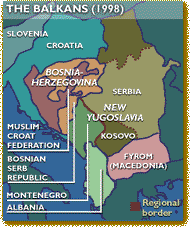
For example, the former Republic of Yugoslavia, since its birth in 1945 under the strict control of overwhelmingly dominating Serbs , hardly survived for 47 years as a single united country until it disintegrated into 5 different independent nations after 1992 after a lengthy civil war (1992-1999) that primarily arose from the dissent of ethnic Slovenians, Croats, Bosnians, Macedonians , Kosovo Albanians against the Serbs. The ethnic Slovenians and the Croats were the first ones to go, then came Bosnians and Macedonians. Serbia, the last remaining stronghold of formerly (overwhelmingly) dominating Serbs itself broke down into Serbia and Kosovo in 1999. Yugoslavia had disappeared from the map of Europe and the world.
|
| Neta_ji |
Posted
on 16-Jul-03 08:23 PM
Did the cold war between Baburam Bhattrai and Ram badahur Thapa (aka Badal) subside?
|
| Nepe |
Posted
on 16-Jul-03 09:44 PM
Neta ji,
Very thought-provoking essay there.
While I believe that for the sake of fairness, we should not judge our remote past with today's standards, for the same reason, I believe that we should not accept the burdens of history without questioning them. And the questioning is basically to ask if anybody is getting hurt by them. And the rest will follow itself.
While the last decade of ours failed politically, it isn't so culturally. In Kanak Mani's word, right after 1990, we suddenly discovered the real Nepal which turned out to be quite different than what Panchayat was portraying. I think your essay describes just that newly discovered Nepal.
I wish I had more time to comment on your frank and daring essay. I certainly agree with you that the current chaos is not an accidental development, but a result of our denial and failure to address serious political and social questions.
And I personally believe that Nepali people are capable to run a modern state.
I have greatly enjoyed reading you, Neta ji. Do keep writing.
|
| KaleKrishna |
Posted
on 17-Jul-03 02:12 AM
Netaji, there is no doubt that your projection is on right tone, it is for nations interest (or are you for disintegrated states like the example of former Yogaslav).
However, is ethnic opression the only reason?. How much ethnic opression does exists now? Is the ethnic based militancy as the case of Khummuban and others who may follow its footstep (thanks to political mileage gaining effort by the maiosts).
Let us hear what you propose for overall development of all citizens of the country (preserving ethnic identy and national identity (if you feel it should exist))
Nice thought, need more participation from learned elites of Sajha forum to brainstorm on the topic. However sorry for the originater of the thread we may be bit out of the context.
|
| Neta_ji |
Posted
on 17-Jul-03 08:06 PM
The following data of PUBLIC SERVICE COMMISSION speaks volume about how disproportionate the share of different social groups have been. Moreover, the present trend is worryingly disturbing. Percentage of the various social groups in the total number of civil servants and it's comparative trend during the following period stand as below: With the ever growing emergence and growth of consciousness and education among the disadvantaged social groups, their participation and share in the national and local affairs have continued to dwindle. The emergence and growth of awareness and education have not helped change their state of reality. This may explain that there is something more than awareness and education that has seriously hindered long over due integration into the society. Education and awareness (and lack of it) may not be the actual cause leading to such a situation as suggested by many of the readers during the discussion.
1983 1993 2000
(I) Khas 69.3 80.5 96.9
(II) Newar 18.6 10.7 1.1
(III) The rest 3.0 2.5 0.0
Note: The share of the combined population of the first and the second group is approximately 10% of the total population of the nation.
|
| Neta_ji |
Posted
on 17-Jul-03 08:57 PM
Thanks NEPE and KaleKrishna for putting some thoughts of yours into the argument. I appreciated it.
Kanak Mani Dixit is very realistic and honest when mentioning about the state of political and cultural reality after 1990. The change in 1990 had been a very rare opportunity not only for a drastic political change towards the openness but also for the change in race relations between the ruling castes (class) and the ruled castes (class) to reconcile a more than two century old long overdue process to mend the battered relationships. The Constitution of 1990 did provide almost all constitutional and legal provisions to ensure political rights and freedoms however when it came to race relations it not only failed miserably but also created major obstacles for any reconciliation to take place in course of time.
There had been a large burden on part the Constitution of 1990 to do the right thing. It not only could have played a part of paramount legal tool to break down all existing legal hindrances that had been a so overtly against the principles of social equality in democratic society but also a medium of providing compensatory act to some of the most shattered social groups that suffered such a beating from the ruling castes (and the state mechanisms they controlled) that it might take several decades for them to rise to a certain acceptable level in terms of social, political, economic and educational. development. Therefore it can be concluded that the ruling class was still not ready accept the openness and social, religious and cultural equality even in the 1990s as underlined by some of the disgraceful provisions of the Constitution of 1990.
The chairman of the Constitution Drafting Commission and later Chief Justice, Vishwanath Upadhyaya, called all demands concerning religion, language, caste and ethnicity, which comprised about 90% of the public recommendations, as being of minor importance for a democratic Nepal, comparing them to communalism:
-- ��Statements which foster communalism and sow the seeds of religious intolerance cannot be justified. Such improper tendencies, if not checked in time, will create obstacle in our efforts to establish a democratic constitutional system.��--
Only a non-Hindu alignment is regarded as communal can be seen from Article 112 (3) which denies the recognition of any political party or organization formed on the basis of religion, community, caste, tribe or region. Must not the state itself be called communal because of its Hindu affiliation? This is further verified by the fact that after 1990 regional parties were recently recognized as long as they did not oppose the Hindu state (for example Nepal Sadbhawna Party is the only regional party with almost exclusively made up of people of the Madesh region and does not oppose Hindu state). Now, this particular provision of the constitution [Article 112 (3)] has proved the most damaging (suicidal article) to the system. (for more of such constitutional provisions please scroll up and read my previous submissions under this same topic ).
If the Constitution of Nepal 1990 still remain in effect (though it is no longer valid in the Maoist controlled territories as claimed by the Maoists), should and must have had granted full rights to form political parties and organizations on the basis of religion, caste, tribe or region. It was the only means for and by which the previously un-represented and underrepresented groups of ethnicity, religion and region could have had received opportunities to represent themselves in the matters of national and local affairs at the national and local level and highlight their concerns at national and local level of the society, politics, administration and economy.
Removal of such provision from the supreme law (even after the years following 1990) of country could/would have had significantly dampen or at least channeled the ever growing demand for separate homeland independent of Nepali state by many of the ethnic groups and their organizations (user KaleKrishna has reminded us KHUMBUWAN as one such example, thanks KaleKrishna). .........continued below
|
| Neta_ji |
Posted
on 17-Jul-03 09:04 PM
More than 12 years have passed since the introduction and implementation of the Constitution of 1990 and not even a single word in the Constitution has been amended that could have better reflected the reality. Various ethnic groups have repeatedly called for changes while in the drafting phases of the Constitution and they have continued to keep the pressure one way of the other. Simply the leaders of then the country�s 2 largest political parties Nepali Congress and CPN-UML could have initiated a change to this provision in the constitution in the years following 1990. It was more than enough for two party�s combined share of the members in the parliament to amend or abolish this provision. They too must have had seen the dangers of the gathering storm however the leadership at national and local level in both of (then) largest political parties were almost exclusively made up of the same ruling castes therefore no one even had a little time to re-think about it and giving a deep thought was not even at a distant horizon. They were not ready for such change. Was it not possible for these so called largest political parties to address the basic political, social, economic and educational needs of these ethnic communities within their party principles? Yes, it was possible but unfortunately they didn�t do it. Not even today, these two of the formerly largest parties have not made any called for discussion within their respective parties or as intra-party and public discussion nor have they included any of such agendas into their party�s political agendas.
Since then, bluntly defying this very constitutional obstacle, in course of last 12 years various political parties and organizations based on ethnicity, religion and region have emerged and have gained a significant support among specific group, religion and region and a very large chunk of their former supporters of the Nepali Congress, CPN UML etc have moved into such ethnic organizations and parties. It was going to happen and with the growth in consciousness in these groups after all the times had changed and it was no longer the time period of 1800s.
Outlawed and out-caste by the supreme law of the country these ethnic political parties and organizations have found refuge in the Maoist organization. This can explain why there is an overwhelming participation of organizations and parties belonging to various disadvantaged ethnic groups. The most of the ethnic groups may not be (and is not ) supporting and getting involved with the Maoist revolt purely for the sake of establishing a communist political system and they know the fact that they cannot go forever with the Maoists as their social and cultural aspects is not compatible with the strict communist system like the Maoism however at least they are making either a short term or medium term transitory coalition with the Maoists.
Since the beginning of the Maoist revolt both (the Maoists and the ethnic nationalists) seems to have had and are benefiting from this coalition. The Maoist are receiving sympathy and inactive (and active) support from these ethnic groups which is helping the Maoist amplify their propaganda. On the other hand the ethnic nationalists from large number of various ethnic groups have found safe heavens (created by the Maoists by driving out or at least weakening the state mechanisms) to further go ahead with their own agendas without (if not with minimal) interference form the state powers. This may explain why did the nation�s (former) largest political parties have become the greatest losers not only in terms of previously held support from these ethnic groups (net loss) but also in terms of spheres of influence as a whole (or gross loss). With the emergence and substantial growth of ethnicity based political parties these ethnic groups have not (and will) not only rejected the nation�s so called (formerly) largest political parties but also see them with an eye of hatred.
Why did the KAMAIYAs of the southern plains of mid-west had to wait until the year 2001 to break free from an age old slavery and still find themselves in limbo. Why do the PRAJA & RAUTEE in Makawanpur district communities always have to wait for aid from the charities form the UK, Canada and the United States to get even the basic needs for life in their community. Why are Canadian charities running even the basic form of schools in the heavily populated Tamang communities of (no far than neighboring districts of KTM) of Kavre and Makawanpur as well as elsewhere? Similarly why do the Tharus of southern plains have to wait for the Amnesty International to have their horror stories of the war to be told to the World.
Why does it take a long sought and long overdue demands on racial and ethnic participation, equality and rights to be put forward as one of the prime needs of the nation by legally obscure (if looked strictly form the legal validity in accordance to the existing law and constitution if there exists any) political parties and organization like the Maoists. Why did it received some attention only after initiation of some armed revolt ?
The Maoist may or may not remain as a center of focus, may or may not remain as a powerful political force or may transform into something else in the days to come but we are sure about one thing. They (the Maoists) have taught or at least inspired to these ethnic groups to stage an armed revolt. If they can do it now alongside the Maoists, it is certain that they will do it with or without the Maoists. Have we failed just in maintaining political balance or have not we failed in terms of race relations too?
|