
| Sajha.com Archives | |
| Username | Post |
| Nepe | Posted
on 05-Mar-04 02:57 PM
Salute to Charitrahin Cheli. Your declaration makes our half-hearted, compromise-minded women rights advocates representing the establishment and the elite, dwarf ! You name alone exposes the fraudulence that thrives behind label and characterization in our society. We indeed need more 'Charitrahin' chelis, more 'anushasanhin' karyakarta, more 'gaddar' soldiers, more 'aatankakari' freedom fighters, more 'paagal' poets, more 'sanaki' buddijibi and so on. rl/qxLg r]nLsf] d'lQm3f]if0ff xfdLeGbf cl3sf, xfdL;"u}sf / eljiodf cfpg] ;a} ljb|f]xL gf/Lsf] ;Ddfgdf xfdL …v/faÚ xf}+ eGg xfdLnfO{ nfh nfUb}g . …c;nÚ eGg] zAbn] k'?ifk|wfg ;dfhnfO{ ;w} p"rf] agfO/x]sf] 5, To;}n] cfkm"nfO{ rl/qxLg eGg kfp"bf xfdLn] uj{ dx;'; u/]sf 5f}+ . lkt[;Qfn] gf/Lsf nflu ;f]Rg, af]Ng / ug{ tf]s]sf ;Lldt ljifosf] kl/lw xfdL tf]8\b} hfg]5f}+ . xfdL dg, jrg / sd{n] s'g} klg a]nf s'g} klg s'/f ;f]Rg, af]Ng / ug{ ;S5f}+ . xfdL cfkm} / ;dfhleqsf ;a}vfn] e]befjlj?4 n8\5f}+ . ;a}lt/sf …v/faÚ / zf]lift gf/Lx¿sf] ;fy lbG5f}+ . uDeL/ tyf cy{k"0f{ ljifo, clwsf/ / ;Toaf/] xfd|f] s] ;f]r 5 eg]/ cfh xfdL ;+;f/nfO{ leGg / j}slNks b[li6sf]0f k|:t't u5f}{+ . ;a} gf/L -cfOdfO{, :jf:gLdfG5], :qL, dlxnf, t?gL aflnsf_ x¿sf] lxtsf lglDt xfdL lgDgcg';f/sf] 3f]if0ff u5f}{+ . != s'g} Ph]G8f agfpg' jf gagfpg' xfd|f] v';L / :jtGqtfsf] s'/f] xf] . s'g} klg Ph]G8f xfdL xfd|f] OR5f / cfjZostfcg';f/ agfp"5f}+, s;}n] nfb]sf] ef/ af]Sb}gf}+ . @= xfdL e"ldut 5f}+ lsgeg] oxf"d'lg ;fx|} /dfOnf] 5 . xfdL tkfO{+sf] cf;kf;, uNnL, sfof{no / tkfO{+sf] 3/df ;d]t 5f}+ . ofb ug'{;\, tkfO+{ xfd|f] lgu/fgLdf x'g'x'G5 ††† #= xfd|f ljrf/x¿ :jtGq 5g\ . xfdL dw'/ / ;'l/nf] :j/df af]N5f}+ . xfdL lrRofp"5f}+, rls{G5f}+, emls{G5f}+, xfxfx'x' u5f{}+ / uh{G5f}+ klg . xfdL 7"nf] :j/df xf":5f}+ . xfdL 8fsf] 5f]8\5f}+ . xfdL ;';]nL df5f}{, u'Gu'gfp"5f}+, ufp"5f}+ . xfdL v'n:t s'/fsfgL u5f}{+ . s;}n] xfdLnfO{ r'k nufpg ;Sb}g . $= xfdL :jtGq Jojxf/ u5f}{+ . xfd|f] p2]Zok"lt{sf nflu xfdL s;};"u em'Sb}gf}+, df]l8+b}gf}+, tf]l8+b}gf}+ / xfdL s;}sf] bofsf] eLv dfUb}gf}+ . xfdL ;fj{hlgs :yfgdf kfg rkfp"5f}+ . cfjZos k/] d'Ssf klg xfG5f}+ . v'ndv'nf kl/jf/ lgof]hgsf ;fwg lsG5f}+ . dgn] rfx]cg';f/ xfdL vfG5f}+, dBkfg / w"dkfg h];'s} u5f}+{ . xfdLafx]s s;}n] xfdLnfO{ lgoGq0f ug{ ;Sb}g . %= xfdL sDAof6 a'6 nufp"5f}+, kfln;n] xfd|f gª /ª\ufp"5f}+, skfn 5f]6\ofp"5f}+, 6f6]kfª\u|] a|f / k]G6L nufp"5f}+ jf a|f / k]G6L gnufpg klg ;S5f}+ . cyf{t\ xfdLn] nufpg] sk8f, xfd|f h'Qf, xfd|f] s]z z}nL, xfd|f uxgf / z[ª\uf/;fdu|L ;a} xfd|f cfºg} ;'ljwf / cfgGbsf lglDt x'g]5g\ . ^= xfdL ljgf cj/f]w 3'dlkm/ u5f}{+ . xfdL tL 7fp"df 3'D5f}+ hxf" dlxnfx¿ k'Ug] ck]Iff ul/Gg . 3/, sfof{no / l5d]sL6f]nafx]s cg'dlt glbOg] tyf :jfut jf ck]Iff gul/g] :yfgdf xfdL lgw{Ss k|j]z u5f}{+ . &= xfdL ;a}vfn] k];fdf nfU5f}+, Tof] k];f hlt;'s} …cdlxnfk"0f{Ú eP klg xfdLnfO{ dtna 5}g . *= xfdL kfl/jfl/s e"ldsfnfO{ k'gk{l/eflift u5f}{+ . xfd|f] klxrfg xfd|f afa'sL 5f]/L, nf]Ug]sL :jf:gL, bfh'efOsL lbbLalxgL, 5f]/fsL cfdf jf gfltsL aHo} x'g'df dfq ;Lldt 5}g . xfd|f] cfkm\g} JolQmut klxrfg 5 . (= xfdL;"u :tg, of]gL, euf+s'/ / kf7]3/dfq xf]Og d[uf}nf, sn]hf], kmf]S;f], k]6, d'6', kfrgu|GyL, cfGb|f, cf}+nf / gª, kfv'/f, v'§f, u'Ktfª\usf /f}, 5fnf, cf"vf, d'v, cf]7, lha|f] klg 5g\ . k'?if;"u gldNg] eGbf ldNbfh'Nbf w]/} cª\u 5g\ . ;a}eGbf dxŒjk"0f{, ;a} JolQmdf x'g] :jtGq dl:tis, efjgf, s?0ff / cfTdf klg xfdL;"u 5g\ . !)= xfd|f] z/L/sf] ;fj{ef}d;Qf xfdL;"u} 5 . !!= ;a} ;GtfgnfO{ ;dfg Jojxf/ ug'{k5{ . 5f]/L e"|0fnfO{ klxrfg u/L km\ofSg] sfd ug'{ x'"b}g . 5f]/Ln] klg 5f]/fn] h:t} ;dfg kfngkf]if0f / cj;/ kfpg'k5{ . s'g} klg k'?ifnfO{ xfdL Ú/fhfÚ eGb}gf}+ . !@= s]6f / k'?ifx¿n] 3/sf] sfd ;3fpg'k5{ . k'?ifnfO{ 3/df a:g, ksfpg, ;kmf ug{, 5f]/f5f]/L x]g{ / cfrL ePsf yfª\gf km]g{ k|f]T;flxt ug'{k5{, dlxnfnfO{ 3/aflx/ uP/ sfd ug{ s'g} cj/f]w x'g' x'"b}g . ;fy}, lbgel/ sfd u/]kl5 k|To]s lbg lgM;t{ lgoldt dfln;sf] Joj:yf xfdL klg dfu u5f}{+ . !#= xfdL dfl;s /h:jnfnfO{ k|fs[lts dfG5f}+ . o;df xfdLn] nfh dfGg'kg]{ / 5'jf5"t ;xg'kg]{ s'/f 5}g . aRrf hGdfp"bf cfdf k|b"lift x'lG5g\ eGg] klg xfdL 7fGb}gf}+ . To;f] eGg' d"v{tf xf] . dlxgfjf/L, ue{jtL, k|;"lt / To;kl5sf] cj:yfdf gf/LnfO{ :ofxf/;';f/ / ;Ddfg ug'{k5{ . o;n] g]kfnsf] nHhf:kb pRr dft[d[To' b/lj?4 d'sflanf ug]{5 . !$= xfdL ;:tf], ;'/lIft / k|efjsf/L c:yfoL lgof]hgsf ;fwg hxf";'s} kfpg'k5{ eGg] dfu /fV5f}+ . k'?ifnfO{ sG8d–k|]dk|lt k|f]T;fxg u5f}{+ . !%= r/d of}g ;'v k|fKt ug{' xfd|f] clwsf/ xf], t/ xfdL oltdf dfq ;Lldt /xg rfxGgf}+ . !^= xfd|f OR5fk"lt{sf lglDt …of}g ;fyLÚ 5gf}6 ug{] clwsf/ xfdLd} ;'/lIft 5 . o;df ju{, hft, hghftLo klxrfg, /fli6«otf, wfld{s ljZjf;, pd]/ jf lnª\u afws x'g] 5}g . !&= hf];'s};"u efjgfTds / af}l4s ldqtf uf":g] clwsf/ xfdLd} ;'/lIft /fV5f}+ . !*= xfd|f] rfxgfa]u/sf] s;}sf] ;DaGw uf":g] k|of;nfO{ xfdL c:jLsf/ u5f}+{ . …gfOÚ eg]sf] …gfOÚ g} xf] . of] s'/f tkfO{+nfO{ yfxf 5 < yfxf 5}g eg] zAbsf]zsf] kN6fOxfNgf];\ . !(= ljjfxn] of}g b'/frf/ jf anfTsf/ ug]{ cg'dltkq lb+b}g . k'?ifx¿ xf] † olb gf/Ln] 6fpsf] b'Vof] elG5g\ eg] pgnfO{ 6fpsf] b'v]s} xf] . Tolta]nf sG8d xf]Og l;6fdf]nsf nflu xft a9fpg';\ . @)= afn of}gb'/frf/ / of}gzf]if0f c:jLsfo{ 5g\ . o;nfO{ ;fj{hlgs / bl08t ug'{k5{ . o;af6 kLl8t x'g]x¿sf] ;fj{hlgs x'g] ;fx;sf] xfdL sb/ / ;dy{g u5f+}{ . @!= s]jn 3[l0ftx¿n] dfq aflnsf / gf/Lx¿nfO{ x}/fgL lbG5g\ . ;8s, ;fj{hlgs :yn / ;fj{hlgs oftfoft, sfof{no / sfo{ynf] tyf kl/jf/df x'g] of}g b'Jo{jxf/, xf]nLh:tf rf8df gf/Ln] ef]Ug] ckdfg / a]n'gsf] uf]bfO cflbsf] xfdL 86]/ lj/f]w u5f+}{ . ;8s uNnLdf 9'Sg] as'Nnf eutx¿n] gf/LnfO{ …lh:Sofpg]Ú sfdaf6 gf/Lsf] cfTd;Ddfgdf wSsf kbf{ xfdL qmf]lwt x'G5f}+ . o;nfO{ u}/sfg'gL agfcf}+ / ;a} kL8snfO{ gfª\u]emf/ kf/f}+ . @@= s'g dxfd"v{n] d'n'sL P]g agfof] < -/, s'gs'g dxfd"v{¿n] o;nfO{ lr/:yfoL agfP <_ b; dlxgf k]6df aRrf kfNg] cfdf, gful/stfsf] xsbf/rflx" afa' < xfdL ;dfg gful/stf dfu u5f}+{ . gf/Ldfkm{t\ klg p;sf] nf]Ug] / 5f]/f5f]/LnfO{ gful/stf k|fKt x'g'k5{ . afa'ljxLg aRrfx¿, xfd|f wd{k'q÷k'qL, s[lqd uef{wfgaf6 hGd]sf afnaflnsf, 6]:6–6\o'a gfgLx¿ / xfd|f l8Da jf Snf]lgªaf6 hGd]sf aRrfx¿ ;a}nfO{ gful/stf k|bfg ug'{k5{ . |
| Nepe | Posted
on 05-Mar-04 02:59 PM
@#= kf;kf]6{ lng / ljb]z hfg dlxnfx¿n] afa', nf]Ug], cleefjsx¿sf] cg'dlt lng'k5{ eGg] ;f]r s'g xl/n7\7ssf] xf] < !* jif{ pd]/ k'u]kl5 xfdL 3'dlkm/sf] k"0f{ :jtGqtf pkef]u u5f}{+ . of] :jtGqtfnfO{ ;Lldt ug'{eGbf /fHon] cfkm\gf] bfloTj k"/f u/L xfdLn] ofqf / sfd ug]{ tyf a:g] ljb]zL d'n'ssf ;DalGwt /fhb"tfjf;dfkm{t\ ;'/Iff k|bfg ug'{k5{ . @$= ljjfxkl5 xfd|f] lx:;fsf] k}lqs ;DklQ bfh'efOnfO{ lkmtf{ ug{ xfdL c:jLsf/ u5f}{+ . of] xfd|} dfq xf] . @%= Psn dlxnfnfO{ wd{k'q÷k'qL lng] sfg'gL clwsf/ lbg'k5{ . @^= xfdL aflnsf / dlxnfnfO{ ljgf cj/f]w lzIff lng / kl/kSj ePkl5 d]sflgS;, zNolrlsT;s, ;Dkfbs, GofofwLz, ljB'tlj1, ul0ft1, s"6gLlts, 6\ofS;L rfns, l;sdL{, k'hf/L jf wfdL OToflb h];'s} aGg kfpg'k5{ eGg] dfGotf /fV5f}+ . @&= dlxnfsf] >d k'?ifsf] eGbf sd dxŒjk"0f{ 5}g, To;}n] ;dfg sfdsf] ;dfg Hofnf kfpg'k5{ . 3/leqsf] sfdnfO{ klg >dsf ¿kdf dfGotf lbg'k5{ . dlxnfsf] ;xof]usf lglDt agfOPsf] >d sfg'gsf k|fjwfgx¿df afn x]/rfx ;]jf / k|;"lt h:tf sfdnfO{ a9L Jofjxfl/s agfOg'k5{ . @*= xfdL r]nLa]6L / dlxnf a]rlavg ug]{ bnfnx¿nfO{ sfg'gL sf/afxLsf] dfu u5f{}+ . of}gsdL{ dlxnfnfO{ lu/km\tf/ ug{'sf] ;6\6f ltgsf s'6'gL / bnfnx¿nfO{ sf/afxL ug'{k5{ . of}gsdL{nfO{ ;a} vfn] df}lb|s, ;fdflhs / zf/Ll/s zf]if0f tyf of}ghGo ;?jf /f]uaf6 hf]lug;Sg] u/L ;zSt kfg'{k5{ . @(= dlxnflj?4 lx+;f ug]{ k'?ifx¿ c/fli6«o tŒj x'g\ . Ps rlr{t cWoogcg';f/ b;dWo] 5 axfnjfnf GofofwLzn] :jf:gLnfO{ 7Ls kfg{ nf]Ug]n] clncln lk6] x'G5 eg]sf 5g\ . -lk|o GofofwLzx¿ † s'/L–s'/L–s'/L † tkfO{+nfO{ cem} nfh nfu]g <_ #)= b'O{ jf b'O{eGbf a9L :jf:gLsf nf]Ug]n] ;fj{hlgs sfof{nodf k|j]z kfp"g]5}gg\ . xfdL nf]Ug]dfG5]nfO{ p;sf] lghL / ;fj{hlgs g}ltstfsf cfwf/df ;fj{hlgs sfof{nosf lglDt klxrfg ug]{5f}+ . #!= bfOhf] eg]sf] gdL7f] …hf]sÚ xf] / cfkm\gL a'xf/L leœofp"bf bfOhf] lng'ePsf] 5 eg] tkfO{+ ck/fwL …hf]s/Ú xf] . xf–xf–xf † #@= xfdL ;zQm dlxnfnfO{ dg k/fp"5f}+ / af]S;L / lsrsGgLk|lt P]Soa4tf JoQm u5f}+{ . ##= ljwjflj?4sf] s'g} e]befj xfdL dfGb}gf}+ . pgLx¿n] /ftf] /ª\u ckgfpg tyf k|]d / ljjfx ug{ kfpg'k5{ . #$= dlxnfnfO{ l56f] / ;'ne ;fdflhs / sfg'gL Gofosf ;fy} ;kmf cfGtl/s zf}rfnosf] ;'ljwf k|fKt x'g'k5{ . #%= lsg @) k|ltzt dfq < cfwf ;/sf/L kbx¿ gf/Lsf lglDt cf/lIft x'g'k5{ . Gofo / ;dfgtf Jojxf/df x'g'k5{, sfuhdf dfq xf]Og . kl/0ffdljxLg sfuhx¿ dfly plNnlvt zf}rfnodf k|of]u u/f}+ . #^= olb xfdLk|lt s'g} /fhgLlts kf6L{sf] df]x 5}g eg] xfd|f] klg pgLx¿k|lt s'g} em'sfj x'g]5}g . tkfO{+ xfd|f] ;dy{g rfxg'x'G5 eg] tkfO{n] xfd|f lglDt sfd ug'{k5{ . ;a} /fhgLlts kf6L{sf] g]t[Tjdf cfwf gf/LnfO{ /fVgf];\ . t/ ofb ug{';\, xfdL tL gf/LnfO{ dfq ;dy{g u5f}+{ h;sf] /fhgLlt gf/L–d}qL 5 . /fhgLltsf nflu xfdL k|of]u x"'bf–x'"bf jfSslbSs eO;s]sf 5f}+ . clt eof] . #&= xfdL k|wfgdGqLsf ;fy} u[x, cy{, k//fi6«, /Iff, sfg'g, Gofo / ;+;bLo dfldnf, ko{6g tyf gful/s p8\8og, v]ns'b tyf lzIff, hn;|f]t tyf ef}lts of]hgf, pBf]u tyf jfl0fHo, lj1fg tyf k|ljlw, e"ld;'wf/ tyf Joj:yf, ;"rgf tyf ;~rf/, s[lif tyf ;xsf/L, hg;+Vof tyf jftfj/0f, jg tyf e"–;+/If0f, >d, / :jf:Yo dGqfnodf dlxnf g} dGqL agfpg dfu u5f}{+ . zfxL g]kfnL ;]gfsf] k|wfg ;]gfklt klg gf/L g} agfP/ x]/f}+ g . #*= k'/fgf] 9/f{sf] ljb|f]xaf6 xfdL yfls;s]sf 5f}+ . eb|sfnLaf6 l;+xb/af/;Dd Kn]sf8{ af]s]/ k|bz{g ug'{ ;dosf] aaf{bLafx]s s]xL xf]Og . o;n] xfd|f] kmf]S;f]nfO{ k|b"liftdfq u5{ . xfdL xfd|f] /fhgLlts cEof; clx+;fjfbL u'l/Nnf /0fgLlt ;d]taf6 u5f}{+ . #(= xfdL bf]xf]/f] dfkb08df ljZjf; ub}{gf}+ . ;fj{hlgs hLjgdf Pp6f / lghL hLjgdf csf]{ Jojxf/ xfd|f] x'"b}g . xfd|f] rl/q cfO{P;cf] ())#– k|df0fkqk|fKt 5 . $)= xfdL ;a}vfn] dlxnfx¿sf] ;Ddfg u5f}{+ . ju{, hft, hftLotf, /fli6«otf, wd{ / lnª\u leGgtfnfO{ xfdL :jLsf/ u5f}{+ . xfdL gf/Lsf] ljljwtfnfO{ Wofgdf /fv]/ sfd u5f}+{ / ljkGg gf/LnfO{ ;De|fGt dlxnfn] 5fof"df gkf¿g\ eGg] rfxG5f}+ . lgisif{df, lkt[;Qfn] ;dfhdf 7"nf];fgf] eGg] txut dfGotf l;h{gf u5{ . xfdL ;a}vfn] ;fdflhs txut e]befjnfO{ c:jLsf/ u5f}{+ . ;fj{ef}d cfTdfx¿sf] xfd|f] elulgTjleq sf]xL 7"nf] 5}g, sf]xL ;fgf] 5}g, sf]xL pRr 5}g, sf]xL gLr 5}g . ;a} ;dfg–;f]r ePsf JolQmx¿;"u xfdL :jtGqtf, ;dfgtf / d}qL efjgfsf ;fy xfd|f ;fgf / 7"nf, ;fj{hlgs / lghL ljb|f]xdf ;xof]u ug{ cfx\jfg u5f}{+ . -rl/qxLg r]nL …k5\of}/LnfO{ Roftr't kf/f}+Ú eGg] p2]Zo lnPsf] Pp6f e"ldut ;d"x xf], hf] lgoldt¿kdf sf7df8f}+df cfk;df e]63f6 / ukmufkmdf Jo:t 5 . p;n] of] …3f]if0ffkqÚ o;} b}lgsaf6 cfh} ;fj{hlgs u/]sf] xf] . _ |
| Nepe | Posted
on 05-Mar-04 03:01 PM
Source: Today's Kantipur Daily. |
| u_day | Posted
on 05-Mar-04 04:32 PM
Thank you NEPE ji! So far I read only first 20 clauses. Then I thought it's just BS. I think they should add another clause. It should be: "HAMI SUDDA NEPALI LEKHNE PRAYAS GARNE CHAU" Don't they do editting in kantipur anymore??? |
| ashu | Posted
on 05-Mar-04 06:18 PM
Unless these Charitra-heen Chelis come aboveground to start taking responsibilties for this manifesto, this news will end just like it started: as a mere sensational piece of news for a day or two. In Nepal and among Nepali societies, it's easy to make grand declarations from one's hole in the ground. Doing so is fun and easy, which, I suspect, CC members are doing. But it's difficult to opt for the less glamorous, less sensational route: Like fighting for one's ideas in public, trying to win over the skeptics and the doubters with reason, shepherding one's ideas with persistence to success . . . and so on. oohi ashu ktm,nepal |
| Gokul | Posted
on 05-Mar-04 07:42 PM
If these CCs are serious in what they are saying they will do, then this manifesto is not their emancipation but another form of slavery. If their intention is to be sensational, then they will succeed for a couple of days. First of all, this is only a crude reaction to the injustice that females have been experiencing in our societies. Let me tell you why it is crude and unwise. Look at number 4. How can drinking and smoking lead to their freedom? Are women in Nepal suffering because they cannot smoke and drink freely? What a gross idea! They will be free when they succeed in making their male counterpart quit these bad habits. In this context, what maoists tried to do in some villages is more commendable than these so-called freedom seekers. Look at 5: How misguided their concept of freedom is. They still consider themselves some objects of decoration and fashion. 15 That means they will do anything or seek any means to get their orgasm. Consider its implications. Look 16. They will fulfill their sexual desire without any regard to age and gender as well. That means, they will not hesitate to sleep with a child or another women as well (wonder why #20). Do you really think that lesbianism will promote their freedom? They definitely have made some positive statements also. But there is nothing new there. Many people and institutions are doing just that without trying to sound "sensational" like these CCs. Have they said these things? They will make female education mandatory. They will punish their drunkard husbands. They will not consider themselves mere sex objects. Hence, they will enforce simplicity - no makeups etc. They will make married life a true blessing by being educated, caring, and strong. Rather they have said just opposite of these. They are just reacting. The positive changes that they want in Nepal can be done in a quiet, disciplined and sustainable manner. Not by promoting anarchy and promiscuity like this. Maobadi destroying physical infrastructure, these CC destroying social fabric, what else ? |
| Biswo | Posted
on 05-Mar-04 10:37 PM
Oh, boy. People say knowledgeable people out there in KTM know who are these Charitrahin Chelis are. And yet the communique is from 'underground'. Now it seems to me apart from the good old Mohan Bikram Singh, a charitrahin Chelaa of left politics since decades, and ruthless Maoists, we-thought-they-were-in-the-west-til-they-hit-bhojpur, Charitrahin Chelis are the only underground fellas these days. You know what, I am afraid of these ladies, but outside I must display my masculine pride, and feign potency, and here is my message, 'go ladies go'. But for a conservative like me, Gokulji's objections strikes the chord! So, 'go Gokulji go'. Never before I acted like such a teflin politician. |
| vivid | Posted
on 07-Mar-04 02:38 AM
Dherai din pachi sajha surf garne kram ma yo thread le ankha tanna safal bhayo. Yesma ma afai pani cheli bhayeta pani mero sochai Gokul dai sanga milna gayeko ma duebidha chainna bhanna hichkichaundina. CC ka harek udghos haru bibhinna patra patrika marfat padne gareki chu rai pani kata kata antar kuntar bata ma so pangti bhitra afai lai aja samma samabesh garna sakeki chaina. Yesai sambandhi mero sochai ko manchitra : Mero Kathmandu: Sunya sunya kuhiro bhitra, Kathangriyera ungdai che Bichipta hridaya ma malham lagauna Alikati okhati bokeko jhari Badaal lai paincho mangdai che Durgandhit khola ko deel deel Saya gaja ko ribbon finjauna Bideshi sangstha haru samu Haat failaundai che Bagmati ganhaune ghar haru Kinara bhari bhari ubhinda Prahari sangai ankha chim garche Goji ma alikati nyano paune asha ma Kuinneto sangai kundiyeka Thote zebra crossing tarda Durghatna pareko herera Khissa dant dekhaundai Traffic jayanti manaunche Desh ko manchitra punaankit garna Harek chaubata haruma roadmap bichaundai Mini ra micro haruko bhidma Pradushan ko ghumto finjaundai Nirlajja hank die raheche Harek raat haruma Badhyata ko kathgharama ubhinne Nagar badhu haru sangai Asmita khoj ko aadma bhatti dhaune Charitraheen cheli haruko chitkar bhitrai Gantabya heen harai rahekiche Mero kathmandu, Urantastari chadi mangal graha pugne Mitho sapana polta bhari bokera Bholika ujjwal din herna Manakamana gardai Ashabadi pratikchyama tolai raheche. Sochai afno afno! Lau ta sabai lai namaskar! |
| Nepe | Posted
on 07-Mar-04 06:02 PM
Vivid, You disappeared after Sajha gathering in Kathmandu. Welcome back to Sajha. This thread was badly needing women's perspective. Your's is a wonderful start. Before I share mine, I couldn't wait to type your poem in devnagari for easy reading of Sajha readers. So fitting, so telling ! 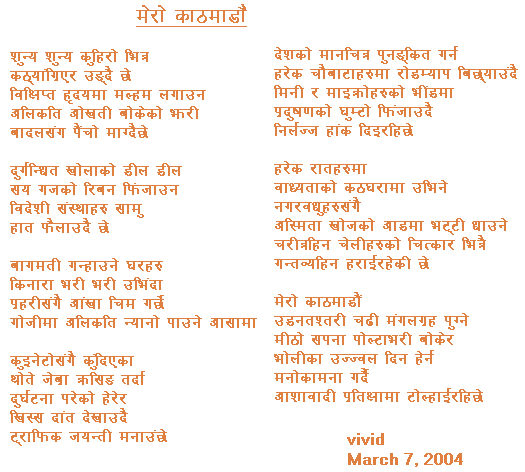
|
| Nepe | Posted
on 07-Mar-04 08:32 PM
test |
| Nepe | Posted
on 07-Mar-04 08:34 PM
One more MAN who salutes Charitrahin Cheli ... - http://www.nepalipost.com/discussion.html#219 |
| Nepe | Posted
on 08-Mar-04 03:24 PM
I am waiting to hear all frank, guarded, general, specific, supportive, critical, humorous, serious, biased, dispassionate, indecent, decent and anything in between views of the diverse community of Sajha on this sensational manifesto of CC. It will be great if some spokeperson of CC comes to Sajha to respond to our curiosity, criticism or indifference, if we chose so, to the historical declaration of their manifesto. What else can be a better place than this forum of anonymous posters for the undergound CC to be and publicize/defend their mission ? Meanwhile, I would like to thank U_day, Ashu, Gokul, Biswo and vivid for their posting. Until CC themselves come and take this thread in their hand, I, a well wisher and sorta fan of CC, perhaps can reply to these gentlemen and gentlewoman. At worst, I will be sharing my personal views, if not defending them on their behalf. *************** Ashu's suggestion for CC to have courage to come overground and take responsibility for their manifesto is a responsible advice which will go a long way to ensure CC comes out as a responsible group rather than a short-lived sensation-maker. However, I think we can wait and see at this point of time as this is just the beginning. At the same time, with some idealism and sense of responsibilty, you can do a lot while still being underground. And there are certainly certain things you can do a lot better and more easily underground than above the ground, for example recruting, particularly until a critical mass of people who are willing to listen to you without any prejudice becomes available. *************** Gokul ji has made more serious observation and also gave a strong reaction. He recognized that CC has made some positive statements but he is apprehensive of other statements which he finds more a crude reaction to the existing injustice to women. His caution about interpreting freedom and sensitivity to the social fabric are major points of interest to me. I don't doubt the wisdom and the sense of responsibility that are in Gokul ji's views. However, I think, if we interpret CC's statements slightly differently and focus on the essence rather than the details of their philosophy, they might not look as crude and threatening as they sound. Let me elaborate. First the most fundamental thing. Their mission. The way I read, I think the mission of CC, even though they have not phrased it in my way, is NOT the emancipation of women in terms of emancipation itself. Emancipation is subjective, subject to interpretation, vague, inexact and difficult to measure, let's say Heisenbergic. What one takes for emancipation may be slavery to others. What can better illustrate this than the words Gokul ji used to describe CC's stement on drinking and smoking ? (I'll comment on smoking and drinking later). So, isn't there an exact, certain, free of bias and interpretation, readily recognizable and felt, simple and understandable by all, irrespective of education and IQ, way of measuring the emancipation of women ? There is. And there is only one. And that is the relative measurement with a man's right and facility he is enjoying ! If and when a woman's condition is at par with man's right, status and dignity or lack thereof, a woman can be assumed emancipated. She might not be emancipated in reality, but we have no OTHER way to know for sure. Therefore, I think, the mission of CC is emancipation of women through or by being at par with where a man is in every thing possible. And let us not forget, you can do it bidirectionally- by pulling man "down" to where woman is or by going "up" where man is. Therefore CC's statement on smoking, drinking or any other thing "bad" thing man does is not meant to promote these bad things. They are meant, in essence, to give the message that they are "equally" bad to a man and a woman. How bad are smoking and drinking are is a separate health related issue. On another point, but still in the same vein, CC are not promoting promiscuity and anarchy. They do not want anything more than they need to be at par with their male counterpart. Promiscuity, if that is called so, and their freedom to choose or not to choose cosmetics are merely their declaration that their body and mind belong to themselves, not to the rule crafted by men for their own pleasure. Gobinda Andhikary ji has elaborated the importance of such right (search of existance) in his piece in NepaliPost. Once again, the essence, limitation or scope if you like of CC is to be par with their male counterpart. They can not compromise that. For everything else, they are human too. Let's talk about that. (Sorry for sounding a spokesman for CC !) Now remained the most difficult question. Social fabric. That's for some other time. |
| noname | Posted
on 08-Mar-04 06:09 PM
We have seen aftermath of neglecting the rebellious 40 points forwarded by the Maoists. The 40 points were grouped, analyzed and interpreted only when it was too late. Not to repeat the same mistake, let me take the freedom to regroup the Chelis' 40 points here and interpret it so that main message does not get swept away in sex and orgasm. Preamble 1. We are free to our will [1, 3-7], and we are free to act according to the will, including but not limited, to selection of sexual partners, for sexual pleasure, and to say 'no' [15-18]. 2. We have individual identities, minds, sprits, souls and bodies [8-9]. 3. We have sovereignty over our bodies. [10] 4. Methodology: We are underground, ubiquitous [2] and adopt non-violent guerrilla tactics [38]. 5. Our demands: i. Children should be treated equally [11]. ii. Men should share daily chores. [12] iii. Easy and cheap access to condoms [14], iv. Care and honor for women during pregnancy and menstruation [13], v. Make harassment illegal and publicly shame all perpetrators [21] vi. Equal rights for women [22-24, 27] and quick and easy access to justice [34]. vii. Single women should be legally allowed to adopt children [25]. viii. Household work should be recognized as a form of labor [27]***. ix. Empowerment for sex workers [28]. x. Half posts in government and political parties for women [36]. 6. Declarations: i. Marriage is not license for rape [19] ii. Incest and sexual exploitation is unacceptable and should be punished [20]. iii. Go girls go [26]. Not only Ministers, but even PM should be women [37]. iv. Shame to men committing violence against women [29]. v. We shall judge men in public on their private as well as public morality [30]. vi. Dowries are a joke [31]. vii. We express solidarity with boksis and kichkannis [32]. viii. No color-coding for widows [33]. 7. Pledge: We pledge not to let elite women overshadow women who are less privileged [40]. *** (I think this has already been effective from the last census) ############# Methodology I support all sorts of rebellions against the authority provided it's unarmed and non-violent. I support all JULUS, all marches and all forms of protests including Bandhs to put pressure against the state. However, time has proved that Bandhs are not effective tool of protest in a country like Nepal. From Bandhs the pressure is more on public, who are supposed to support the protest, not on the government, which is the target. This is the reason Gandhi used JAIL BHARO, BHADRA AWAGYA, SATYAGRAHA, DANDI MARCH as tools for protest against the British. In Nepal, I have seen JULUSH as the most effective tool of the protest. 2036 was brought by JULUSH, 2046 sal was brought by JULUSH, and (2061) sal will be brought by the JULUSH again. But Chelis seem to adopt another unconventional methodology! Unarmed Guerrillas! They say they are watching all, and can appear anywhere and anytime! They are mixing Gandhi and Mao, be careful! Demands and declarations I have no objection to any of them but no. 14 (listed 5(iii) above). No. 14 is acceptable only if there is no compromise in the quality ;) |
| ashu | Posted
on 09-Mar-04 12:24 AM
What follows is from Manjushree Thapa Enjoy, oohi ashu ktm,nepal *************** Ashutosh, Interesting conversation going on there. I don't have time to go and register and log in, but the next time you're there, can you please post this message on my behalf-- I've been following the Charitraheen Chelis' declarations, including their earlier articles, and think they're an expression of our times. In Nepal, the feminist movement has been scattered; this is obviously just another addition to that scattering, but it is a refreshing one. One thing that immediately strikes me is their call for socially liberal mores, alongside the usual left/liberal political demands that other feminist groups in Nepal make. This is something that is entirely missing from the feminist dialogue in Nepal. My own experience, and the experience of other professional women, is that we spend (or waste) a lot of energy fighting off the misogyny all around us, and no matter how clear we are in our feminist thinking, this has the effect of wearing us down. I think [Ashu's] suggestion that the group come above-ground is insensitive, in that it doesn't take into account the tremendous personal risks women face in going even just a little 'out of line.' Again, in my experience, women who in any way break the sattesavitri mold must face not just censure and derision from men, including their family, friends and colleagues, but also physical threat--of sexual harrassment or rape. (I've written in Nepali Times about this, in an article called 'Misogyny Amid the Intellectuals.') If the women in this group remain underground, it is probably because they do not want to invite such hatred--which abounds in our society--upon them. I do not think it is fair to ask them to do so. That said, there are women all over Nepal breaking their social confines. Last year, when I was in Kalikot speaking to 12 to 17 years' old Maoist girls, they all shared with Kathmandu's '[Himalayan Java' = a restaurant in Thamel =] type [of] the same desire for social liberalism. They too are breaking out of traditional roles--working and traveling with boys and men--but being judged as 'charitraheen' for doing so; they too are caught in the middle. One of the many revolutions going on in Nepal is a sexual revolution; it is time that we recognize this, and recognize that this is related to the bigger revolutions we're undergoing. It seems to me that the Charitraheen Chelis are an expression of this. cheers M |
| Biswo | Posted
on 09-Mar-04 01:18 AM
This is not my reaction to CC's manifesto. I just want to add something about women's situation in Maoism. I found it to be a consensus view among the Chinese elders that women's status in China ameliorated greatly after 1949. Women were more downtrodden in China before 1949 than they are in today's Nepal. Unfortunately, with the normalcy of capitalism returning to China, women are the first one to lose their right. Even more sadly, unborn women are the first one to lose their (fundamental) right (to live). Abortion of unwanted child raised dramatically in 90s, almost all of the unborned child being a girl.So, though changes brought forth by the Maoists and other dictatorial systems tend to be evanescent, and has a recidivist propensity, the Maoists try sincerely to bridge the gender inequality gap. Thanks Manjushree for sharing your thoughts. I also enjoyed your recent article in the Nepali Times very much. |
| noname | Posted
on 09-Mar-04 03:38 AM
Ashu thanks for posting Manjushree's view. ***** I disagree with the view that these CCs need to come aboveground for longevity of their declarations. I don't think those working for change in, to quote Manjushree's words, 'social liberal mores' need to be in the scene continuously forever, as the political parties do. They come, pick issues, strike them, the society brainstorms them and accommodates some of them (albeit uncomfortably), which later becomes norms. Next generation comes and picks from where the earlier generation has left, or sometimes their work is overlapping. No need to survive these Chelis forever. They have made their point, and if they can push it a bit further, that should be enough ! To make a note here, the feminist movement in the West was not continued by a specific group. First generation struggled for the voting right, second generation worked for the individualism, and now the third generation is in the offing. Only thing the CCs have, I suppose, to do is make their case strong, and that they can do more effectively working as CC TV, hidden but watchful. What they are trying to change is the individual behavior, where publicity helps more than organized pressure. Look at their success; only couple of months in the media, and they are already topics of discussion in MARTIN CHAUTARI. No need for them to appear in the CHAUTARAI, others are representing them! ********* I also disagree with the view that "it [coming over-ground doesn't take into account the tremendous personal risks women face in going even just a little 'out of line.' " What I gather from their working methodology, declarations, pledge and HO-HALLA is that they are all educated, urban and 'privileged' and powerful women with voice. Most of the sufferers of 'personal risks women face' belong to uneducated, underprivileged women without voice. Sita Pandey wrote some bold and critical essays in 'YAUN ra ANUBHUTI (?).' She was not harassed, but praised for her courage. CCs should work underground, only if they can make their case more effective from there (for example, only a handful of women can make strong case from underground!). Harassment is a lame excuse. |
| karmapa | Posted
on 09-Mar-04 05:34 AM
Just educate the girl child and you are going to see all items on the Manifesto take care of themselves. This sniper approach (emphasis on the education of the girl child) is probably better than the easier shotgun approach (issuing a Manifesto) in addressing some of the root problems associated with gender inequality/inequity...some of which go beyond patriarchy. But apparently the former approach is not nearly sexy, glamorous, and sensational enough in today's fad-driven world. Many items of the manifesto - because they are surfacial and cosmetic - (and this is the good news) are actually achievable: why even fight for the kind of freedom that many women are already taking for granted left and right. For example, many are already doing the 'unwomanlike' work that the 'charitrahin chelis' say they don't mind doing. I do not even bat an eye anymore...considering the history of womenfolk esp in the north. Indigenous mountain communities, for instance, have usually been matriarchal and mountain women were already far too liberal (than puritanical America, that crucible of sixties-type feminism that we are now beginning to see in Nepal) and held positions of influence in their respective societies - it was only when they later outmigrated that they came smack against the rigid patriarchal Hindu society and adopted the mores of that society - ie became Hinduised/Sanskritised. Even today, as a rule of thumb, as you go from north to south or from east to west, you find the society increasingly patriarchal/Hinduised, and the women's positions relative to their menfolk correspondingly weaker. In the west, in the heartland of the Khas, they have a saying: 'If a male stranger talks to a woman, there's going to be a quarrel with her husband in the evening.' Well in this respect, I think especially the Hindu/Hinduised womenfolk of Nepal have a work cut out for them. Religion as much as the state stand in the way of their freedom - methinks. Well good luck with headbanging!!! Last but not least, methinks there was really no need to issue a laundry list of demands or notices. Just issuing a following one-line manifesto would have sufficed: "Give it [freedom] to me now, or I'll take it anyhow". |
| isolated freak | Posted
on 09-Mar-04 06:51 AM
I totally agree with Manjushree's views on this: Chareetraheen Chelis or not, Nepal in general and Kathmandu in particular was experiencing some sort of sexual revolution for the last few years. If yoiu looik at it from the anthropological point of view, it was bound to happen. People travelling to other countries, internet, TV, hear-say, economic oppurtunities or lack of it, all can be attributed to the changes taking place vis-a-vis gender roles in Nepal. In the rural area, it was the Maoists who started this, among the ones who came back from their work abroad or even Kathmandu. I have no problems with the CC's manifesto. It just shows that the time is changing, and we have to make adjustments to our culture, if we want our culture to survive. Just this week, I had a very interesting discussion on Cultural Changes with some students here.W e all agreed that, the conservative appraoch to cultural preservation doesn't work at all. The more you try to preserve the traditional aspects, the faster the culture changes. Finally after 3 hrs, we came up with this anology: Culture/tradition is a small house. If you have guests or new family members coming, you just adjust your arrangements so that the new members or guests can be adjusted. For this, you move things here and there, change the way your room looks etc. These changes in the arrangement don't mean that you cease to be the owner of the house. The house will be still there and you still own it. However, if you do not wnat to make adjustments, then you will be isolated (no guests will come), and endangered (since there will be no new family members). So, to continue to be a part of the society you live in and to not get extinct, you have to make adjustments. Someone, came up with the China example which is a little off from the reality: China's women's liberation movement started in the rural areas since the last days of the Ming Dynasty (circa 1600s). In the rural areas, the whole idea about feminism, gender roles and everything changed in the later years of the Ming. Similar to the Industrial Revolution era Europe, women due to economic hardships had to work in the family farms, and according to Jonathan Spence (the Search for Modern China), women had the equal rights to make decisions within the family. However, this was in the rural areas among the poor peasants. According to Susan Mann (Women in China's long 18th Century) Urban women wrote poems, studied the classics, became good painters and in socme cases taught their kids history and the Confucian classics in the 18th century. During the Taiping heavenly movement of the mid 1800s (A guy woke up one day to realize that he is the brother of Christ, and that his duty is to liberate the Chinese people from the Qing tyrrants. He amassed a lot of poor Chinese and started a rebellion and finally ceased Nanjing, where he started the Taiping Heavenly Kingdom), women had rights equal to that of men. Probably this was one of the reasons Marx became a fan of the Taipings. In the later days of the Qing Dynasty, following the proposals of Zeng Guofan, Kang Youwei and Liang QiChao, the Qing dynasty was making adjustments to its policies and was embarking on the reforms. One aspect of this reforms was to have the missionaries schools which were protected by the state. The young Chinese who studied there admired the nuns who took care of them during their schooling, one of which was the first Chinese student to Yale and to America, Yung Wing. Also the nuns and the missionaries started teaching the Chinese women, this gave them the oppurtunity to travel to America for further studies. Not long after the Qing dynasty's collapse, a group of Chinese women students were studying at the University of Michigan to become surgeons. |
| isolated freak | Posted
on 09-Mar-04 07:22 AM
With the iconoclast May 4th movement spreading all over China, and the revolutionary writings of Li DaZhao, Chen Duxiu (who became the founding members of the CCP in the 1920's) and Cai YuanPei (educated at Cornell and Columbia and who became one of the most admired presidents Peking University) on the "new youth" was spreading the mesasge of communism, socilaism, women's freedom etc. They all attacked the traditional institutions such as arranged marriage etc. The women in China were attending schools, colleges, learning English and travelling abroad. Some even went to Weselyan (?) to study, for example, the Soong Sisters. Some went to Japan. Some went to France. There they learned about freedom and the first thing they did was they defied the arranged marriage tradition. They satrted marrying their boy friends. China went through a crisis from 1911- 1949. However, after the establishment of the People's Republic of China in 1949, women had a lot more freedom. One reason for this was, Mao admired women's help which he recieved during his early Jiangxi, Jiangnan days, and the bulk of the revolutionary army was made of women. Since they had participated in the revolution, it was obvious that they would get the same privilidge as their male counterparts in the Post-revolution days. One of the first policies of Chairman Mao was to ban the institution of arragned marriages altogether. In the 50s, China went through its most ambitious development project, often called the Great Leap Forward. Everyone was expected to work in the vilage communes or work units. Although the goal of economic development wasn't met, it helped in reducing the gender disparity by a great deal in the society. The 60s saw the Great Proleteriat Cultural Revolution (1966-1976), also called the 10 years of chaos. Similar to the Great leap Forward, it didn't actually yield anything tangible-constructive or productive, it nonetheless sent many urban women into rural areas, where the former taught the latter about their rights. Some women went on to work at the heavy-plants. To show that they were equal to their male counterparts, they would cut their hair short and wear the same dress. Often called the Iron Brigade Ladies, they did help in "smashing" the feudal remnants of the society. (for more on this, please see, Personal Voices). China went through yet another social economical transformation in the late 70s. Now, with the four reforms, China opened its door to the foreign investments and started to dismantle the work units danwei and village communes. Soon the western products started entering China. With the products came the culture: Women soon started to wear fansy clothes, spent money on buying fashion accessories and the whole cocnept of beauty was redefined. Now, being beautiful didn't mean having short hair and wearing the men's dress, now, it meant looking like the Revlon model. However, the state made sure that this new concept wouldn't change the gender roles or revert the society back to the traditional "feudal" days. The state kept on empowering women. With the economic reforms yielding positive results starting the 90s, the women have become more powerful. They work, they make money and they spend money on whatever they like. These days, the concept of Urban Beauties is becoming popular in China. These Urban Beauties are successful women, who are single, educated and rich and for the most part own their own businesses. One of the Feb issues of Beijing Review carried a cover story on this new social class. The story prasied the women for taking independent stand and for choosing to do things taht makes them happy. Interestingly, the next issue had a discussion on whether single women should have the rights to make use of the artifical technologies to become mothers! Also, if you folllow the news in China closely, one of the most talked about persons of China last year was Ma Zumei, who wrote columns dealing with sex for various magazines and even had her sex diaries online. So to say that women's conditions are deteriorating in China after 1978 or it was only after 1949 the women started to enjoy power is historically and anthropologically wrong. |
| isolated freak | Posted
on 09-Mar-04 07:24 AM
The Chinese women are now trying to come up with a balance between professionalism and feminism, and this I a- someone who was almost an anthro major duruing the first two eayrs of school- find very interesting. |
| isolated freak | Posted
on 09-Mar-04 09:10 AM
it was the Maoists who started this, among the ones who came back from their work abroad or even Kathmandu.= it was the Maoists who started this, along the ones who came back from their work abroad or even Kathmandu. |
| isolated freak | Posted
on 09-Mar-04 09:36 AM
Since I am not that able to particpate in dicsussions every day, save for sometimes, and will probably not be able to answer every questions on the board (if there are any), here are some of the books that might help you answer all your questions. If nothing works, and if I do not happen to answer in Sajha for a longer period, please send me an email: Books on China/Chinese Women: 1. The Search for Modern China, Jonathan Spence 2. Precious Records: Women in China's Long 18th Century, Susan Mann 3. God's Chinese Son: Hong Xiuquan and the Taiping Heavenly Movement, Jonathan Spence 4. Personal Voices 5. Feb. 2004, issiues of Beijing Review If interested more in Chinese society, please read: FanShen, Willian Hinton Chen Village, Anita Chan The House of the Lim(s), Marjerie (Sp?) Wolf For history (from ancient to modern) China: A New History, John King Fairbank Other interesting anthro books to help you analyze cultures and women's issues: 1. Patterns of Culture, Ruth Benedict 2. Nisa, Marjorie (sP?) Shastok |
| Biswo | Posted
on 09-Mar-04 02:02 PM
>Someone, came up with the China >example which is a little off from > the reality: China's women's > liberation movement started in >the rural areas since the last days >of the Ming Dynasty (circa 1600s). So,what was little off from reality? I wasn't talking about women liberation movement. What I wrote conforms to reality. |
| GurL_Interrupted | Posted
on 09-Mar-04 02:11 PM
Very interesting reading some very different perspectives! To those, that are taking everything as stupidity, I am just curious to ask, "Is there anything WRONG in asking to be treated fairly?" Don't u think, it's about time nepali women are allowed and encouraged and not discouraged to make their own mark in the world? But how can it be possible, when we are being criticized left and right every time; and not taken seriously for asking & fighting for our rights...something that we should not have been denied in the first place! |
| sense | Posted
on 09-Mar-04 02:34 PM
I wonder what our society would be if all these so called feminist NGOs n INGOs give even a portion of their incoming donations in the awareness of girls eduction? I guess Charitrahin chelis should focus more on making so called feminist high ranking officials having cocktail party after each so called meeting aware of the fact that the barbeque they r eating is nothing more than the cotinuity of the pain that each n everywomen in sudurpaschim is facing everymonth during their periods. |
| aardvarak | Posted
on 09-Mar-04 05:48 PM
i wonder how come CC forgot one of the most important points that will bring our chelis to the same status as their male counterpart " We have the right to swear 24/7 if we want to. 'Ma......',' Mu...' et etc are not the sole property of Mu..kta haruko" "If guys can walk, play or simply sun bathe bare chested, why can not we do? We have the right to bare ourselves where ever we want, when ever we wnat" PS-oh cant wait to see that |
| Gokul | Posted
on 10-Mar-04 08:36 AM
The points mentioned in their manifesto can be divided into: personal, and societal issues. My own feeling is that CCs really want their personal freedom but are using societal issues to give their manifesto an aura of objectivity and judicious concern toward society. Why? (1) Fist of all, these CC are likely some well-to-do women from Kathmandu who can afford to go to disco and drink and dine regularly. While most people in Nepal are having difficulty even to get two square meals, these CCs obviously do not have that economic constraint. So, this shows that CCs do not represent the majority of Nepali people, let alone Nepali women. The only problem to them, it seems, is the culture that raises a finger to them for their "unwomanly behavior". But is this also true? One who has been to the discoes in Kathmandu can easily see girls and women freely smoking and drinking (and perhaps also taking drugs in some places). Is there really a culture that is stopping them from partaking these habits and being equal to the males? I only wish we had such a strong sense of what is right and what is wrong. (2)Second point is that the issue of smoking and drinking is not necessarily male vs female. In elite society and ironically also in the low society, women freely smoke (cheap Ganesh bidi if not 555). This fact can be verified from the national data pertaining to women mortality attributable to smoking diseases, which shows that more women then men die in Nepal due to smoking. If women are not allowed to smoke, then where are they getting these diseases from? Don't tell me it is just second-hand smoking from men. Except in some ethnic tribes, women often drink with men in their homes. Just like smoking, women drinking is pervasive in both elite and low class. It is only in the middle class and most likely in Bahun and chetries, males drink but forbid hypocritically their females from drinking. The point is that smoking and drinking are not the national level male vs female issue. (3) Sexuality is an immensely personal and intimate topic and it can be handled only with the deeper understanding between husband and wife. CCs have commoditized sexuality by asking it to be available anywhere, anytime, and from anybody. They have not even seen the necessity of marriage as an institution. It reminds me of (For want of a nail, the shoe was lost ...). (4) CCs' other points regarding economic justice and equal opportunity are commendable. However, I feel that they are just using it as a platform to launch their previously mentioned issues. Why? First of all these societal issues need massive economic reforms - education and free markets are the key tools. When women are educated -they can be independent and strong economically, physically. Free markets will bring the competion between everybody, not the friction between males and females. In some jobs females will surpass men, in other jobs men will do better. The distinction will be made by the economic system, not artificially. Since a small underground group in Kathmandu (representing only selective women issues) can bring only changes in their personal lives but cannot do any national level reform ( that needs a different perspective than those exhibited by CCs), it is logical to assume that they are using serious societal issues as free rides to serve their myopic, self-centered, and self-defeating interests. (5) On a philosophical note, the manifesto of CCs is a reaction and hence representative of some aspects of our very complex society. To portay these issues in stark male vs female terms and initiate a campaign not on natural wisdom and empathy but on vengeance and nihilism is to do great injustice to our very tolerant and flexible culture and society. I only hope that these CCs will not bring a sexual revolution similar to political counterpart of maobadi's revolution. These sinister efforts always start with some of the most positive ideas. Is it not said," Every cloud has silver lining"? The immediate whiteness of silver dazzles the impending gloom of the cloud. (6) I definitely hope the one wish of CC come true: that they remain underground forever. |
| Deep | Posted
on 10-Mar-04 08:45 AM
Vivid, Wonderful expression. Dhilai bhaye pani mero prasamsa purana bhaktajanka hatbata bihanko udaudo surjelai herdai jhareka jal-thopa jhai yahako rachanama samarpit gareko chhu. |
| SITARA | Posted
on 10-Mar-04 09:53 AM
Perhaps, the intentions were lost in the translation or perhaps purpose was confused in the intentions. Despite, the fascination that CC seem to have snowballed into motion, the defiance in choice of title and the "explicit demands" or expression of sexual desire/satiation smacks of justification of personal agendas, which would otherwise be looked upon as inappropriate. Reminds me of a rock band sending messages of "anything goes". Could it be the revisitation of the "hippy era" with shade of elitist bend? I agree with Gokul ji's observation of parroting social evil while justifying personal vices. The shroud of mystery, the flaunting of "eye brow-raising" habits, not to mention a bold tongue-in-cheek narration in a popular newspaper/magazine give the agenda just the touch it needs to keep readers hanging on. Trendy and hyped up, just like our Madonna in her pornographic pink saree with all the drapings of a satee savitri 14th centuary seductress. Don't get me wrong. There have been strong women who have managed to change the Laws of the land. The inheritance laws for women are changed; we didn't see no CC make it happen. There have been suits filed by rural women in search of justice in inheritence. Obviously, there were/are educated females working toward a better society to make progress possible for every other female in the land. Influencing their male counterparts to see the inequality in the laws is a far more effective way to bring about changes; wouldn't you agree that getting the partnership of the other half of the population would be a better option? Progress is/was never about women against men or vice versa. Empowering women should not mean humiliating men. Many of the development programs in the villages are NOT sustainable just because the males/husbands/brothers opinions were/are not sought for. Empowering our women should not mean alienating the men. The CC are doing just that. Theirs is just another nara (on of many politicized) that has not taken to the streets. In times of chaos (like our country's), theirs is a delayed adolescent phase a backlash of the belly piercing, MTV generation. "My Body My Wish" is not about freedom but about freedom with a responsibility! |
| Lalupate*Joban | Posted
on 15-Mar-04 10:19 PM
The Cheli stuff is refreshing. It makes a good read. I like feminist stuff. Would certainly have gone to see the Vagina Monologues on V-day if life had not been reduced to one heck of a race against time this past Feb. Sexual revolution in Nepal is welcome. Let Kathmandu be the new Mecca of sexual awakening! |
| Nepe | Posted
on 17-Mar-04 03:04 PM
I had hoped that CC will show up here and participate in this brain storming. Gokul ji and Sitara, two giants of Sajha, have posed some very serious questions regarding the intention, scope and methodology of CC. Others who have found CC's manifesto a bold declaration of women's freedom at both individual and collective level also deserve to hear from CC and to gauge how reliable and competent the group itself is. While that may happen or not, I thought I'd bring this thread up again for more discussion. We certainly have not exhausted the discussion yet. So let me add my own reaction to some of the points various posters have made so far. ******************************* To Noname ji, Thank you for forewarning us about the probable price of neglect. To some that may sound paranoid, but in Nepal nobody has more accurately predicted future than a paranoid would do, me thinks. Thank you for taking care to organize the points from the CC's manifesto. I agree with your disagreement with those who have disagreed with CC's methology of working underground and for not necessarily coming to take over the baagdor of everything of women issues. You have rightly identified and appreciated the importance of a force like CC in bringing about the change by their role of being a sensitizer rather than a being a conductor or a full time broad leadership. To every change there is always somebody who brings the first shock. To every gradual change there is always a beginning, transition or a rapid phase. If the change is not towards the overall degradation, then the only question we should ask is how much sensitization is not too much. I think this is where we should put CC to determine their relevance. On a related note, you wrote that Sita Pandey was praised for her bold writing about sex and nobody harassed her. By some, yes. However, there was no dearth of men who showed utter disrespect to her. But this should not be surprising to anybody at all. On the same note, I am surprised to see nobody commented on that terrible incident with Sapana Pradhan Malla that Manjushree brought up from her article from NepaliTimes. I will comment on that shortly. ******************************* To Karmapa you wrote: Just educate the girl child and you are going to see all items on the Manifesto take care of themselves. If you meant a total education (formal + informal), then you are right. If you meant only a formal education, you are not right. This sniper approach (emphasis on the education of the girl child) is probably better than the easier shotgun approach (issuing a Manifesto) in addressing some of the root problems associated with gender inequality/inequity...some of which go beyond patriarchy. I wouldn't view them as two different or mutually exclusive approaches. CC's manifesto is simply a part of informal part of education. It simply complements, intensifies or speeds up what should be coming from the formal education. Further, Karmapa ji brought up very interesting note on the existing variation among various social groups of Nepal regarding the status of women. It's true that in non-Hindu (except the Muslims of course) and low caste Hindu groups, women enjoy more freedom than they have in the high caste Hindu groups. This point should be noted by those who might think women's freedom is a foreign concept to Nepal and that it might bring a havoc in our society. ********************* |
| Nepe | Posted
on 17-Mar-04 03:06 PM
******************************* To Manjushree, Manjushree is probably the most qualified person among us to comment on the manifesto of CC. And I will not be surprised at all if CC has some members like Manjushree herself ! That said, Manjushree has rightly recognized that CC came to fill an important part missing from the feminist movement of Nepal. Once again, those who are critical of CC for not being the whole body of women's movement should take note of what M just said and learn to appreciate the 'contribution' rather than being disappointed with what still is left to be done. As I said above, M. brought up a painful but extremely important issue of misogyny among educated idiots in Nepal in her article. Unfortunately that did not find way to Sajha discussion. Gokul ji and Sitara in this thread above have shown their reservation for looking women's issue in a men versus women fashion. While appreciating their caution for us not to create unnecessary conflict between or regarding men and women, I want to make a case from the examples like what Sapana Malla Pradhan shared, that we do have issues that are men versus women and that aggressive approach is necessary and unavoidable too to deal with such issues. Manjushree used the term misogyny. I really don't know it's meaning. Dictionary describes it as 'hatred of women'. It did not make much sense to me. I mean the men described as mysogynic in the article are actually those who do not have hatred towards women. These damaged men actually love women, they love to have them. They love to use them. They become just angry when things do not go their way. Can they be then described as mysogynic ? If mysogynic are those who do not respect women, then it makes sense to me. They love women, but they do not respect them. Yes, this is more accurate description of these damaged colleagues of us, the educated Nepali men. Now, let's recall the incident with Sapana and Manjushree herself and ponder over it. - http://www.nepalnews.com.np/ntimes/issue103/nepaliterature.htm First Sapana's. At the reception, a very august man said to her, without blinking, that some men were so outraged by the court’s ruling that they said that they should rape Malla. That was about the extent of the conversation between Malla and the august man. But in this brief exchange, the man had managed to convey a veiled threat to her, while appearing to chat amicably over canapes and drinks. Let's assume that this august man was not a dumb. Now what do you think about him ? Absolutely, this man is a mysogenic shit. (sorry for my word, but I was imagining Sapana as my own sister, OK ?) I agree with Manjushree's reading that this mysogenic man was conveying his own mesogenyc message and the message of his mysogenic comrade-in-arms. I could tell this with this confidence because I have met utterly mysogenic Nepali men plenty in my life. The way they describe the women they are disappointed with ! You'll throw up ! If you suggest these men to treat women with respect, they will look at you like a KKK fella would look at another KKK fella who has just suggested they should respect a nigro. Political violence against women may not necessarily be mysogeny per se. However, in our male-dominated, both qualitatively and quantitatively, society with plenty mysogynic men or rather with varying degree of mysogynic sentiment among men, mysogeny invariably joins its hand with political violence against women. Such mixture of political violence and mysogeny is even more painful to the victim because the perpetrater gets moral support from his party and the neutral mass tend to overlook or dismiss it as tolerable over-reaction of the perpetrater. This is how I would describe the terrible incident Manjushree had. Now, how to deal with mysogyny ? Or, let's be specific, what to do with mysogenic men and their victims ? To the men, educate them. To the victims, give them justice or a sense justice and, of course, security. Regarding education, in order not to confuse it with school education, let us remind ourselves that we are talking about educated men, often recognized in our society as intellectuals ! Clearly, the ideal thing in this situation is to have a rehab center with well-trained counselors. There, these damaged men will receive education and as a result our victim mothers, sisters and daughters will receive security and a sense of justice. Does not sound feasible ? OK, until this sophisticated and ideal measure becomes feasible and we actually implement it, let's take some immediate measures, even if they are crude, to protect our mothers, sisters and daughters from the threat, damage and humiliation from these mysogynic animals as well as from indifference, ineffective prayers and unaffordable wait of our civil society. Shall we ? In case of the incident with Sapana Pradhan Malla, I will do the followings, * Exhibit solidarity with Sapana * Oppose the mysogynic messenger. Expose him and let him be humiliated with the show of solidarity to Sapana. This will be a good lesson (education) for him for his life. *If this guy really had a good intention, let him prove that by letting him expose those damaged men who suggested to do that dreadful thing to Sapana. * Sue them in a court of law Some of us may find these things a bit harsh and risky. But this will do two important jobs, # These mysogynic men and other in making will know without any mistake that they are wrong # Our women will know that they are not helpless. Now, I will gladly take alternative way, if there is any, that does not have humiliation to these men, to achieve these goals. ******************************* |
| Nepe | Posted
on 17-Mar-04 03:08 PM
******************** To Gokul ji, The way I read, Gokul ji is basically demanding more from CC. He is asking them to go for bigger, larger, higher, and nobler causes. That's fine. However, I wouldn't assume that CC have not thought about larger and nobler causes and conservative ways to go about them. It's pretty much likely that some individuals of these CC work on that front too. It may be just that those conservative ways and forums were NOT SUFFICIENT. I think Manjushree did not find it for no reason that CC fills something missing from the feminist dialogue in Nepal. On sex, Gokul ji probably misunderstood CC. CC has not advocated for extra-marital sex. They are for pre-marriage sexual freedom for ADULTS (>18 years old). How much harmful this may be to us may be arguable. However, in our modernizing society, this is bound to happen and I think what we need is a proper education on sex rather than a ban on sex. I think sexually satisfied youth is more productive and healthier than a sex-starved youth. Economic growth will definitely bring more freedom to women through pure economic competitions. However, that will not be sufficient. The situation of women in wealthy Arab countries is a case in point. Gokul ji further wrote: On a philosophical note, the manifesto of CCs is a reaction and hence representative of some aspects of our very complex society. To portay these issues in stark male vs female terms and initiate a campaign not on natural wisdom and empathy but on vengeance and nihilism is to do great injustice to our very tolerant and flexible culture and society. Indeed a profound and a kalyanbadi note. However, I do not agree with a few assumptions made here. First, I don't think notion of equality to women is against natural wisdom. The natural dissimilarity between men and women is way too little in comparison to the similarity that exists. In contrast, the freedom and rights women are enjoying are way too little as compared to their male counterpart. Second, I am not sure I agree with Gokulji's characterization of our society. Very complex society ? I think every society in the world is complex. In some aspects, our society may be less complex than other societies (let's say advanced ones) are. We know where we want to go and be. Advanced societies are not so sure about what they want ! Tolerant and flexible society ? If our's is a tolerant and flexible society, then CC should be easily accommodated, haina ra ? I think our society is not tolerant and flexible as such. The reality is that certain components of our society are 'tolerant' and 'flexible' (examples- women, lower caste people, janajati, madhesi etc) and they contribute to the overall stability and peace in the society. Gokul ji may be right about who CC individually may be and about their individual interests. It was also right of him to point out the things left out and to alert about the risks. However, I find him more focussed on the empty half of the glass rather than the filled half. CC are there to, philosophically speaking, do a very small, but very important, part of a very a big task. Nothing more, nothing less. This is how I look at them and this is how I have become their fan. ******************************* To Sitara, Sitara has the strongest word for CC and she has made some interesting arguments. I will comment on two points related to methodology of CC and leave the rest for CC to defend by themselves. First, a case made from example of above the ground strong women who succeeded to change the anti-women inheritance laws. This is really interesting story and at one point I was thinking to talk about it in detail. I will do if this discussion continues. Here, I will just a make a point that if you actually follow the whole debate that started in 1993 and ended in March 2002 with a compromised bill, one actually reach to a conclusion that women right activists were not smart and aggressive enough. The compromise was made against and despite a massive support from the civil society and leftist political parties. I will not be surprised if some 'strong women' frustrated with such a stupid setback are behind CC. Whether that is the case or not, we certainly need aggressive and alert women right activists to deal with strongly conservative power. Even from bargaining's point of view, we need somebody to ask for more than what you and me can live happily with. Second point, you suggested CC are alienating/humiliating men. But is it appropriate to put all men in a single basket ? I am also a man and I am not humiliated/alienated ! Noname ji is not humiliated/alienated. So is Isolated Freak. Lalupate Joban found it very refreshing. Ki logne manchhe ma hamro ganti nai hundaina ? Lau ta, I rest my case here. I need some rest for myself too. Lekhdai jaandaa laamo bhayechha guff. Astoo ! |
| Nepe | Posted
on 17-Mar-04 03:17 PM
Misogyny..misogynic.. I have yet to learn to spell 'em correctly. And grammatical errors, typos as usual. Nepe with apology |
| aeiou | Posted
on 18-Mar-04 08:51 AM
Hi. Manjushree here. It's fun to be here, I had checked out sajha about a year ago and had not got back till Ashu emailed me about this posting. Interesting, strong reactions to CHC. Nepeji is, predictably maybe, where my vote goes. I don't think there is any underestimating the hatred (which is based on disrespect, but goes further, in that it is active, pervasive, systematic) that women face in Nepal. What I was reacting to in the piece that I wrote on Sapana Malla was that someone of her stature--who has almost single-handedly brought the feminist movement here to fruition--should have to deal with the kind of crap she does, threats of rape and all the sick pleasure of conveying it. I do know who the judge was to conveyed the message to her, and it is shocking that he should go around every day enjoying the respect of our society. This relates to the experience of many professional women I know in Nepal, who--especially as they reach the heights of their career--face hordes of critics who say 1) she is wrong; and if they cannot win that argument, 2) she is sleeping around with so-and-so. This does not matter to women like me, who are open about their relationships. I grew up in the US, and don't feel any need to conform to Nepal's one-man-through-life policy for women. But for many Nepal women, it hurts deeply to have worked so hard, against so many odds, to become professionally established, only to have men (and women) call them whores / sluts / bitches / easy lays behind their backs. Yes, it may be naive of them not to expect it. We want our feminists to be stronger than they are. We want them to survive all this, and flourish. But many of them succumb to despair and insecurity and even fear for their personal safety, and that uses up much of the energy they could otherwise be devoting to their cause. How does this relate to the Charitraheen Chelis? When I was in Kalikot last year, meeting 12 to 17 year old Maoist girls, and when I am in Java in Kathmandu, seeing teenage girls and young women exercise their choices (latte or mocha?), the one thing that I see in common is the overwhelming desire for change, and fast. (no more gradual-reformism). There are many revolutions going on in Nepal, and one of them is the women's revolution, and this includes the sexual revolution, but it also includes the basic revolution for bourgeois liberties and leftist equalities, and I see no problem with the CC's for at least attempting something new. Sitara--because I gather that you are a woman--why dislike them for not doing enough? At least they are doing something. We can all quibble on their not focusing on, say, land reform as a major agenda for the transformation of Nepal (one of my own quibbles with them), but please, let's be glad for small mercies. Cheers, Manjushree |
| SITARA | Posted
on 18-Mar-04 09:51 AM
Hi Manjushree! Indeed, it is a pleasure to see you here in Sajha-- thanks to Ashu. You are correct in assuming that I am a woman and that I am interested in the feminist movement in Nepal. However, you mis-interpret me when you say "I dislike CC for not doing more". It is the image and the message sent out by the CC that I find bothersome. To elaborate, fighting for personal and social freedom need not be translated into defiant debaucheries, nor should it be tabulated under "charitraheen". There is nothing "charitraheen" about wanting/ desiring personal/social freedom. Perhaps, the sensationalist presentation is one way of capturing the attention/s of the readership but could it also be one more way of putting off people; people who do support feminist issue but who do not subscribe to blatant, scandalous (?) sensationalism?! A revisitation of the first publication on the CC (and those others that followed) smacked of affectations/conditionings from "Cosmopolitan" magazine and elitist kitty parties. As for the issues and concerns about professional women in our society, I absolutely agree with you; there is a genuine fear of being labelled everything but respectable. |
| Gokul | Posted
on 18-Mar-04 10:21 AM
Nepeji, I appreciate your poise, patience and sincere efforts to get to the bottom of things. First, let me respond to a few issues raised by you. ////// However, I wouldn't assume that CC have not thought about larger and nobler causes and conservative ways to go about them. It's pretty much likely that some individuals of these CC work on that front too. It may be just that those conservative ways and forums were NOT SUFFICIENT. I think Manjushree did not find it for no reason that CC fills something missing from the feminist dialogue in Nepal. ////// You may be right here and the CC's manifesto may very well be the outcome of frustration generated by the failure of other feminist movements in Nepal. Since I have no knowledge about it, I will be quiet. ////////// On sex, Gokul ji probably misunderstood CC. CC has not advocated for extra-marital sex. They are for pre-marriage sexual freedom for ADULTS (>18 years old). How much harmful this may be to us may be arguable. However, in our modernizing society, this is bound to happen and I think what we need is a proper education on sex rather than a ban on sex. I think sexually satisfied youth is more productive and healthier than a sex-starved youth. ///////// There is no indication from the manifesto that they are not advocating any extra-marital sex. They say: We know we have the right to sexual pleasure, including, but not limited to, orgasm. We reserve the right to choose sexual partners to fulfill our desires (regardless of class, caste, ethnic identity, nationality, religious belief, age or sexual orientation). ////// Where does it say that they will be bound by the institution of the marriage? They have earlier said that they are individuals unbound by any defining relationships such as daughter, mother, wife etc. Does this not make very clear that they consider extra-marital sex as their rights to getting sexual pleasure? ////////// Economic growth will definitely bring more freedom to women through pure economic competitions. However, that will not be sufficient. The situation of women in wealthy Arab countries is a case in point. ///////// Nepeji, Ours is not a muslim nation which treats women as objects. More on this later. ///////// On a philosophical note, the manifesto of CCs is a reaction and hence representative of some aspects of our very complex society. To portay these issues in stark male vs female terms and initiate a campaign not on natural wisdom and empathy but on vengeance and nihilism is to do great injustice to our very tolerant and flexible culture and society. However, I do not agree with a few assumptions made here. First, I don't think notion of equality to women is against natural wisdom. The natural dissimilarity between men and women is way too little in comparison to the similarity that exists. In contrast, the freedom and rights women are enjoying are way too little as compared to their male counterpart. ///////// |
| Gokul | Posted
on 18-Mar-04 12:08 PM
Nepeji, I am not saying that the notion of equality to women is against natural wisdom. But trying to follow the misguided paths and giving it the name of equality is surely not a wisdom. Our society will be much better if we think men and women as complements rather than arch-rivals. ////////// Second, I am not sure I agree with Gokulji's characterization of our society. Very complex society ? I think every society in the world is complex. In some aspects, our society may be less complex than other societies (let's say advanced ones) are. We know where we want to go and be. Advanced societies are not so sure about what they want ! ///////// Look at how small our country is yet so many different cultures, tribes, sects, religions it has. I am using complexity in the sense of heterogeneity here. Also, we do not have yet a stable political system that can assist us in handling social issues. All these increase the complexity of our country. So we must be very careful in what we do and what we profess lest the lid of Pandora’s Box should open. ///////// Tolerant and flexible society ? If our's is a tolerant and flexible society, then CC should be easily accommodated, haina ra ? //////////////// As I already mentioned, ours is not a muslim arab nation, who theoretically consider women as subservient to men. In presence of education and good economy, these issues will "self-organize". In the absence of education and good economy, these issues will exacerbate. //////// I think our society is not tolerant and flexible as such. The reality is that certain components of our society are 'tolerant' and 'flexible' (examples- women, lower caste people, janajati, madhesi etc) and they contribute to the overall stability and peace in the society. ////// We are politically exploited, yes. That is a different issue. But the belief system in our culture is tolerant because there is no theoretical rigidity to it (like Arab nation). We do not have religious einstellung, the functional fixedness present in so many other nations. |
| Gokul | Posted
on 18-Mar-04 12:17 PM
//////// Gokul ji may be right about who CC individually may be and about their individual interests. It was also right of him to point out the things left out and to alert about the risks. However, I find him more focussed on the empty half of the glass rather than the filled half. ////// Bill Cosby once said,"Is glass half full or half empty? It depends whether you are pouring or drinking." As an outsider who is not affiliated with these CCs, I am more scared with the heavy collateral damages these CCs might do than the petty achievement of libido liberty. /////// CC are there to, philosophically speaking, do a very small, but very important, part of a very a big task. Nothing more, nothing less. This is how I look at them and this is how I have become their fan. /////// CCs are the symptoms of our malady, not the cure. Finally, let me ask you a few questions: (1) Do you agree that CCs are trying to piggy-back grand social reforms in order to give their agenda a tone of validity? (2) Do you not agree that CCs are a handful of elite women with peripheral agenda that do not address the major problem of our society? (3) How exactly are they going to bring changes? Next time, you go to Nepal - you see a bunch of female hooligans drinking and dancing in Durbar Marga. Will your conscience thank this emancipation of exploited Nepali women? More importantly, will be thinking why your sisters and aunts are not there doing their share for this "Naulo Mahila Mukti Andolan"? When in doubt, ask your heart. However, I must also confess that: I may be harboring only antiquated ideas while the statements made by Manjushree may hold more water since she's "been there, done that". |
| Biswo | Posted
on 18-Mar-04 04:13 PM
For intellectual refreshment, I sometimes participate in talk programs organized by Rice's internationally famous journal Feminist Economics. The journal's high profile backers include Nobel Laureaute Amartya Sen, Robert Solow,George Akerlof,Keneth Arrow and UN human development office head Sakiko Fukuda-Parr. I think UChicago's Martha Nussbaum, whose article someone had posted in Sajha long ago, is also in editorial board. Despite these highbackers, and despite being a top resources of feminism, the journal is also in a bad need of new quality scientific information/articles highlighting women's movement.Personally, I didn't like a lot of their women speakers who spent most of their time bashing (american) republicans and everyone who disagreed with them. But, hey, that's the way all liberals of our era work. They want others to be tolerant to their views, but have hard time countenancing the dissenters of their own view. In spite of the obnoxiousness of those women speakers, I liked their presentations. The last one, I vividly remember, was about 10 million missing women. Their point was 10 million women are killed or unaccounted every year either before they are born (because parents don't want girl child) or after. Now, the number spoke more loudly and harshly than those women. But the numbers were more impressive. I think Charitrahin Cheli will be even more effective movement if it provides itself with some more literatures about women's problem. I understand they are relatively inchoate as an organization rightnow. But all I know is for a serious intellectual movement to be started, a thorough study of women's plight need to be done, at least gradually. Without serious intellectual push, any social movements will have hard time sustaining itself. I am more interested to know how many women are tormented each year because they are considered ill witches, how many women would have otherwise divorced their drunkard and infidel husband (hypothetical prediction), how single women(or single mom) with right to family heirloom would fare, how or whether companies are descriminating against women employees by, let's say, reenforcing stereotypes that women can't work as ,say, supervisors thus reducing work opportunities for women. These numbers will speak a lot in changing attitudes. By focussing more on sexual aspect of women's movement, CHC people are able to attract both easy attention and bitter hostilities from a lot of sections of societies. Now, that their first goal of being recognized, sensational, and famous is reached, I guess it is time to do some serious acadamic stuff. |
| Nepe | Posted
on 20-Mar-04 02:58 PM
A nice round of conversation again. I thank all the participants. All of you have elaborated your views and brought broader topics in the discussion. It was a pleasure indeed to have Manjushree again in the conversation. (Your joining Sajha as a registered member is a matter of pride and prestige to us. I do hope you stick with us for long, which means not being discouraged by the overwhelming diversity of postings and anonymous posters in this forum. I hope Ashu has already given you necessary orientation regarding this matter ) As you said, revolutions are happening in many fronts of our society. And this has made our lives both easier and more difficult. More difficult, because we must remain alert and extra careful, and, easier, because we can make things happen. A stagnant society would have been the same in the reverse order. To your emphasis that our feminists should be stronger, I would add they should be aggressive too. As I wrote earlier in a model case of Inheritance law, I think it was lack of sufficient aggressiveness on part of the activists that failed to stop the bill from regressing from where it had reached with help of tears and sweats of many. I recall once Sailaja Acharya was calling upon the activists to be very aggressive regarding the bill. Unfortunately, she could not be her own example. Her own party destroyed the essence of the original bill. I concluded from this and many other cases of neglect to the causes of reforms that we need a new breed of totally committed and damn aggressive reformists and an atmosphere of their existence. I think it was the later context I saw CHC can fit in and hence became their cheerleader. And so long as they do not come up with any regressive agenda, I will keep on cheerleading for them. ******************************** Sitara's reading of CHC seems mostly coming from earlier information. However, her apprehension that the CHC may be driven by imitation of 'Cosmopolitan..kitty party..MTV' culture rather than by a genuine empathy of woes of our women is rightly placed. Her displeasure with CHC's choice of uncomfortable name that does represent a blatant and scandalous sensationalism is understandable too. But, does the same (the scandalous name) not tell that they have a specific purpose which in turn should mean there is no point interpreting it for a general purpose and then criticizing it ? I don't believe that a profound thinker like Sitara has misseed to notice the things that go beyond sensationalism. ********************************* Gokul ji, Impressive arguments there. The truth about CHC is probably somewhere between your skepticism and my enthusiasm. So probably we can do without reaching to a conclusion for now. As an outsider who is not affiliated with these CCs, I am more scared with the heavy collateral damages these CCs might do than the petty achievement of libido liberty ................................. (1) Do you agree that CCs are trying to piggy-back grand social reforms in order to give their agenda a tone of validity? (2) Do you not agree that CCs are a handful of elite women with peripheral agenda that do not address the major problem of our society? At this earlier stage of their campaign, I would prefer to give them a benefit of doubt, so to speak. The basis of this benefit is not my lack of knowledge about CHC, but the knowledge that their 'peripheral agenda' including that of 'libido liberty' can not be essentially achieved without 'grand social reforms'. CHC should now or later come around the larger social agenda any way. As for the 'heavy collateral damages' that may be caused by CHC's petty agenda, interestingly, that was what is in my mind, however in a positive light, bringing me to support them. A more useful discussion would probably be de-abstractization of the collateral damage and cataloging them in plus and minuses. (3) How exactly are they going to bring changes? As I said, I am more interested in what you called collateral damages and I like to term synergy or domino affect of CHC's movement on larger social issues. At the same time their basic call for personal freedom to women is a good thing in itself. Next time, you go to Nepal - you see a bunch of female hooligans drinking and dancing in Durbar Marga. Will your conscience thank this emancipation of exploited Nepali women? More importantly, will be thinking why your sisters and aunts are not there doing their share for this "Naulo Mahila Mukti Andolan"? When in doubt, ask your heart. I am not trying to sound ultra-modern, but I really don't find anything wrong in drinking and dancing by women. As a matter of fact, since my youth I have been conjuring up this strange image and idea that the day a young Nepali boy will drink in a bar sitting next to a Nepali girl and not wondering if she is a charitraheen cheli, I will conclude that Nepali women are now emancipated. Gokul ji has in several places expressed or suggested his fear that the sexual and other liberty CHC are advocating might challenge or weaken the institution or values of marriage, family and perhaps also of unselfishness, abstinence or self-renunciation and other high moral values. I think these values have survived everything in the past and so will in the future of mankind on their own merit and strength. Because they fulfill our need and correspond to our instincts. They are irreplaceable and invulnerable as well. No need to worry about them. The most important thing not to forget when we talk about freedom is that a freedom of choice is not denunciation of one or the other choice, it is simply denunciation of the qualification of the authority who decides things for us. I think we should keep this in mind before fearing CHC. ************************************** Biswo ji, Thank you for your informative posting. And I agree with the job you assigned for CHC. Yes, it's now time for more academic stuff. |